Gosport Protest and the Migrant Boat That Went to Dover: What Actually Happened — and What It Says About Britain’s Border Debate
Hundreds of people gathered at Gosport after reports that a small boat carrying migrants could be brought ashore there. The vessel ultimately went to Dover instead, six people were arrested, and competing accounts quickly emerged over why the destination changed. The episode has become another flashpoint in Britain’s increasingly tense debate over Channel crossings, policing, rescue operations and public confidence in immigration policy.
On Tuesday evening, the waterfront at Gosport became the scene of an unusually intense confrontation over Britain’s small-boats crisis.
Hundreds of protesters gathered near the Hampshire marina after information circulated that a group of migrants who had spent more than a day crossing the English Channel might be brought ashore there.
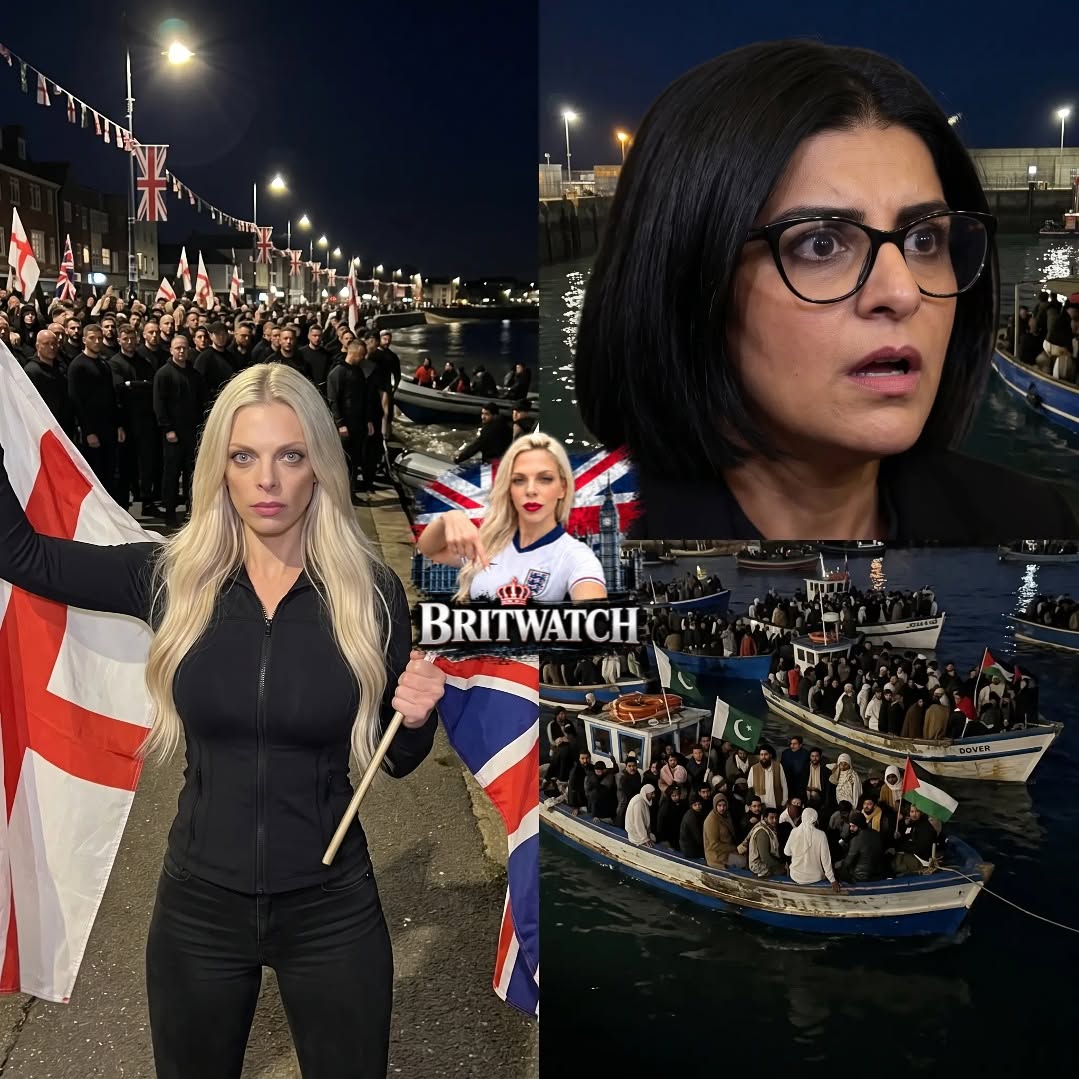
Police officers were deployed. Maritime and emergency agencies prepared for the possibility of an arrival. Protesters assembled near the harbour, some chanting against further migrant arrivals. By the end of the night, however, the vessel carrying the migrants did not dock in Gosport at all.
Instead, 51 people were ultimately taken to Dover, where they arrived shortly after midnight. (Sky News)
The change of destination immediately generated competing explanations.
Some activists claimed the protesters had successfully forced Border Force to abandon plans to use Gosport. Others portrayed the decision as evidence that authorities had lost control of the situation.
But the available evidence does not establish that Border Force simply “turned around because the crowd stopped them.”
What is established is more specific: Gosport MP Dame Caroline Dinenage said she had been told by the Home Office that it was becoming increasingly likely the group would be taken to Gosport. She subsequently said she made the case that they should not disembark in Hampshire, and later announced that Border Force would take them to Dover instead. (Sky News)
Exactly how much weight was given to the protest, operational security, political representations and other considerations has not been publicly established.
That distinction matters because the incident has rapidly accumulated claims extending far beyond what official accounts currently demonstrate.
A Crossing That Lasted More Than 30 Hours
The episode did not begin in Gosport.
According to the French coastguard, the small boat had left the Normandy coast on Monday and spent more than 30 hours at sea.
French authorities said those on board repeatedly declined assistance and were determined to continue toward Britain despite what officials described as precarious conditions. British rescue vessels later attended the boat and its passengers were transferred before being taken toward the UK. (Sky News)
Sky News reported that 51 people eventually arrived in Dover after approximately 36 hours at sea. (Sky News)
That prolonged journey was unusual enough to attract considerable attention before the protest had even begun.
For opponents of the government’s immigration policy, the images reinforced a familiar argument: that Britain’s maritime response effectively completes journeys initiated by people-smuggling networks.
For the authorities and maritime rescue organisations, however, the issue is framed differently.
Once people are in danger at sea, Border Force, the Coastguard and the RNLI operate within maritime-safety obligations. Their involvement in a rescue or transfer does not itself determine whether a person subsequently has a lawful claim to remain in Britain.
That distinction is frequently lost in political arguments about the Channel.
Rescue, border processing and immigration status are separate stages of the system.

Why Did Everyone Think the Boat Was Going to Gosport?
This was not simply a rumour invented by protesters.
Dame Caroline Dinenage, the Conservative MP for Gosport, said the Home Office had informed her that it was “increasingly likely” the vessel would be brought to Gosport.
That information helped fuel concern locally, while news and social-media reports spread rapidly.
Hundreds subsequently gathered at the marina. (Sky News)
The possibility of Gosport being used as a landing or processing location had particular significance because migration operations on Britain’s south coast had already become politically sensitive.
There had been earlier protests in Dover and Portsmouth during September, including confrontations involving demonstrators, police and Border Force operations. (GOV.UK)
By Tuesday evening, therefore, the Gosport situation was developing in an atmosphere where authorities were already acutely conscious of public-order risks.
The Protest Was Large — But It Was Not Literally “The Whole Town”
Social-media commentary has described the event as an entire town spontaneously rising up.
That is an exaggeration.
Reliable reporting describes hundreds of protesters, which is unquestionably a significant crowd for an operational marina, but Gosport has a population far larger than the number who attended.
The distinction is worth preserving.
A substantial protest can demonstrate real local anger without being presented as unanimous evidence of what every resident believes.
Reports also indicate that some participants had responded to calls from activist Daniel Thomas, better known as Danny Tommo, who had been broadcasting events around the Channel. (The Guardian)
Other people may have attended independently because they were concerned by reports of the proposed arrival.
Those motivations cannot simply be assumed to have been identical.
What Police Say Happened
Hampshire and Isle of Wight Constabulary said officers were deployed to Gosport and Portsmouth to allow peaceful protest, protect the local community and support partner agencies in case of a maritime emergency.
The force said that after news emerged that the vessel would dock elsewhere, a group remained in Gosport and some became hostile toward police.
Six people were arrested. (Hampshire Police)
According to police, the alleged offences included assaulting an emergency worker, aggravated trespass and careless driving. (Hampshire Police)
The arrests are important because they illustrate the difficult position facing police in these situations.
Citizens have a right to protest government immigration policy.
They can criticise Border Force.
They can oppose asylum policy.
They can demand tighter borders.
They can peacefully demonstrate outside government facilities.
But police are also responsible for maintaining access to operational facilities and protecting workers and members of the public.
The legal dividing line is therefore not whether a protest supports or opposes immigration.
It is whether particular behaviour crosses into criminal conduct.
Did Protesters Force Border Force to Change Course?
This is perhaps the most important unresolved question.
A simple narrative circulated online very quickly:
Migrants were heading to Gosport → locals appeared → Border Force backed down → the vessel went to Dover.
The chronology superficially supports that interpretation.
But chronology alone does not establish causation.
There were other factors.
Dinenage said she had been making representations to the Home Office against using Gosport.
Police were dealing with a significant gathering.

Border Force staff safety had already become a concern following previous demonstrations.
Operational decisions about where a vessel docks can also depend on infrastructure, processing capacity, maritime conditions and security.
The available official material confirms that the arrival point changed.
It does not, at this stage, provide evidence allowing a definitive conclusion about which factor caused the decision.
The most accurate description is therefore that the vessel had been expected to potentially arrive at Gosport, a large protest formed, and Border Force subsequently took those aboard to Dover.
Anything stronger requires additional evidence.
Was the RNLI “Escorting Illegal Migrants Into Britain”?
That phrase has become common in political commentary, but it compresses several separate questions into one emotionally powerful description.
The RNLI’s role is maritime rescue.
In this incident, British rescue vessels attended a small boat that had been at sea for well over a day.
The individuals were subsequently transferred and processed by border authorities. (Sky News)
Whether an individual has entered Britain unlawfully, whether they qualify for asylum, whether they should be detained, and whether they should ultimately be removed are matters for immigration authorities and, where challenged, the courts.
The RNLI does not decide those questions.
Critics can legitimately ask whether Britain’s wider system creates incentives for dangerous crossings.
They can question whether current interception arrangements effectively guarantee that anyone reaching British waters will complete the journey.
But that is a policy debate about border enforcement.
It is different from suggesting that lifeboat crews themselves determine immigration policy.
Why Police, Ambulances and Emergency Resources Were Present
One of the strongest criticisms following the Gosport operation concerns the amount of public resources apparently deployed.
Images showed a considerable police presence, while critics alleged that ambulances and other services were tied up preparing for migrants who never eventually landed there.
There is a legitimate public-interest question here.
Large emergency operations cost money.
Police overtime costs money.
Maritime operations cost money.
Ambulance standby capacity costs money.
Border processing costs money.
If large numbers of personnel are deployed unnecessarily because operational plans subsequently change, taxpayers are entitled to ask why.
But claims that the operation cost “hundreds of thousands of pounds” need evidence before being presented as fact.
I have not found an official itemised cost for the Gosport deployment.
Nor is there currently public evidence demonstrating that a British patient experienced a specific ambulance delay because an ambulance had been assigned to this operation.
Those assertions may eventually be testable through official data or Freedom of Information disclosures.
For now, they should remain questions rather than established conclusions.
Why Emergency Medical Support Can Be Needed
It is also worth considering why ambulances might be positioned near a migrant landing.
A group spending more than 30 hours in a small overloaded vessel may face dehydration, hypothermia, injuries, seasickness or other medical problems.
Emergency planners cannot know in advance whether every passenger will arrive healthy.
Medical resources therefore may be deployed as a precaution even if they are ultimately unused.
That does not eliminate concerns about resource allocation.
But an ambulance that does not transport anyone has not necessarily been deployed without reason.
Standby capacity is common in emergency planning.
The policy question is whether the level of deployment was proportionate to the expected risk.
The Wider Public-Service Question Is Still Real
The larger concern expressed by critics cannot simply be dismissed, however.
Britain has finite public resources.
Every police deployment requires officers.
Every Border Force operation uses staff and equipment.
Every asylum claim requires administration.
Accommodation costs money.
Legal proceedings cost money.
Removal proceedings cost money.
Healthcare costs money when needed.
If small-boat crossings continue at scale, taxpayers ultimately finance much of the resulting infrastructure.
That is one reason migration has become such a politically potent issue.
Citizens may reasonably ask whether those resources would otherwise have been used differently.
The important analytical step is to distinguish that broad fiscal question from unsupported claims that one particular ambulance or police officer would definitely have prevented a specific unrelated emergency.
Have Channel Crossings Actually Been Rising?
The broader statistical context complicates claims that the government has “no plan” or that crossings are simply being allowed to increase unchecked.
In a statement to Parliament earlier this month, Prime Minister Andy Burnham said arrivals over the summer had fallen by half compared with the previous year and that year-to-date numbers were the lowest since 2021.
He attributed some of that decline to increased French enforcement and said more than 48,000 attempted crossings had been prevented. (GOV.UK)
Separately, reporting this week put the number of Channel arrivals in 2026 at about 17,480, representing a substantial decline from the equivalent period in 2025. (The Times)
Those figures do not mean the small-boats problem has been solved.
Thousands of people are still making the crossing.
Individual incidents remain dangerous.
People-smuggling networks continue operating.
And even lower annual arrivals can represent significant costs and political pressure.
But describing the government’s policy as literally having no measures intended to reduce crossings is not consistent with the available record.
A stronger criticism would be that opponents consider the measures insufficient, too slow, or fundamentally misguided.
Those are political judgments that can be debated against the evidence.
The Government’s Position
The government says Border Security Command is working continuously to secure the border and that arrivals are detained, checked and processed.
Following this week’s incident, a government spokesperson said the command would continue to process every small-boat arrival. (AOL.com)
The government has also pointed toward cooperation with France as an important part of its strategy.
That includes efforts to intercept departures before boats reach the Channel.
Critics question whether cooperation with France delivers sufficient results relative to its cost and argue that deterrence must occur after migrants reach Britain as well as before they depart France.
This disagreement is central to the immigration debate.
One approach emphasises enforcement cooperation, disruption of criminal networks and asylum processing.
Another places much greater weight on detention, removal and making successful entry substantially less attractive.
Does Labour Want Migrants Because They Will Vote for Labour?
This claim requires particular caution.
There is no evidence in the Gosport incident demonstrating that the government arranged migrant arrivals in order to gain future votes.
Nor can people arriving by small boat simply turn up and vote in the next UK general election.
Eligibility for UK parliamentary elections depends on citizenship status and other legal criteria.
A voter must be registered and must generally be a British, Irish or qualifying Commonwealth citizen. (GOV.UK)
There are complexities because qualifying Commonwealth citizens with valid immigration status can have voting rights, and local-election rules vary depending on nationality and location. (GOV.UK)
But the claim that accepting asylum seekers automatically produces immediate votes for the governing party is inaccurate.
Many migrants have no parliamentary voting rights.
Some may eventually acquire citizenship after years of lawful residence, depending on their circumstances.
At that point there is also no guarantee how they would vote.
Immigrant communities are not a politically uniform bloc.
Consequently, a claim that ministers deliberately permit Channel crossings as an electoral strategy would require substantial evidence that has not been provided.
The Pakistan Aid Argument
Another claim circulating alongside the Gosport story links British foreign aid to Pakistan with people subsequently arriving by boat.
Britain does provide overseas development assistance, including programmes involving Pakistan.
But the government has recently announced a broader reduction in the UK’s Official Development Assistance budget as part of plans to increase defence expenditure. Its July 2026 development strategy says the reduced budget will be focused more tightly on humanitarian priorities and programmes intended to advance UK interests. (GOV.UK)
However, simply observing that Britain sends aid to a country and that nationals from that country may later migrate does not demonstrate a causal arrangement between the two.
Foreign aid is typically used for programmes involving health, humanitarian assistance, education, governance, climate resilience or economic development.
It is not a payment to individuals in exchange for migration.
A legitimate debate can still be had over whether aid achieves its intended objectives.
Critics may argue that funds should instead be spent domestically.
Supporters may argue that improving conditions and stability abroad can ultimately reduce migration pressures.

Both positions are different from claiming that aid itself is evidence of an organised migration-for-votes system.
Public Distrust Is an Important Part of the Story
Even where some claims circulating online go beyond the evidence, the distrust behind them should not be ignored.
For many people, the small-boats debate has become a symbol of something larger.
They see highly visible crossings.
They see rescue boats.
They see police escorts.
They hear about hotels being used for asylum accommodation.
They see substantial government expenditure.
Then they hear governments repeatedly promising to secure the border.
When crossings continue, confidence declines.
That gap between government promises and visible reality creates fertile ground for speculation.
People begin asking whether authorities genuinely want to stop the crossings.
Some go further and conclude that officials actively encourage them.
The first question is politically legitimate.
The second requires evidence.
A functioning democratic debate depends on keeping those categories separate.
Gosport Also Exposed a New Public-Order Problem
The episode demonstrated that small-boat operations are no longer only a maritime and immigration challenge.
They are increasingly becoming a policing challenge.
Protesters can use maritime tracking, livestreams and social media to follow Border Force activity in close to real time.
Crowds can then gather rapidly at ports or processing facilities.
That can complicate operational planning.
It can also create difficult scenarios in which authorities must balance peaceful protest against employee safety and access to secure areas.
Government concern about this phenomenon predates Gosport.
A Home Office statement following earlier south-coast protests described approximately 150 people gathering at Dover in a no-notice demonstration earlier in September. (GOV.UK)
Subsequent Portsmouth protests involved hundreds of people and confrontations with police. (The Guardian)
Gosport therefore appears to be part of an emerging pattern rather than a completely isolated event.
Should Arrival Locations Be Kept Secret?
That raises a difficult transparency question.
Local communities may reasonably argue that they deserve to know when substantial government operations are occurring nearby.
Local MPs may need enough information to scrutinise the arrangements.
Emergency services obviously require advance notice.
But publishing precise operational information can allow protesters or others to mobilise around sensitive facilities.
There is no easy balance.
Too little information generates accusations of secrecy.
Too much operational information can make safe processing more difficult.
Gosport illustrates that tension vividly.
The Role of Local Representatives
Dame Caroline Dinenage’s intervention also deserves attention.
According to reports, she communicated directly with the Home Office and argued against bringing the group ashore in Gosport.
She later confirmed that Border Force would instead take them to Dover. (BERJAYA)
That raises another policy question.
If every constituency understandably resists becoming a disembarkation or processing location, where should arrivals be taken?
Dover has historically absorbed a disproportionate amount of Channel-arrival infrastructure because of its geography.
Authorities have therefore explored alternative ports and processing arrangements.
But expanding operations elsewhere creates immediate political opposition.
The national government faces a classic distribution problem: a policy may operate nationally while its physical consequences are concentrated locally.
Why Dover Remains Central


Dover ultimately received the 51 people from this crossing.
That reflects its long-established role in Channel operations.
The town has infrastructure designed to process migrant arrivals and has repeatedly been at the centre of Britain’s migration debate.
But residents and politicians in Dover have also expressed frustration about carrying a disproportionate burden.
Moving operations away from Dover can relieve some of that pressure.
Yet doing so means another town must accept the facilities.
Gosport shows just how politically difficult that redistribution can become.
Were the People on the Boat “Illegal Migrants”?
The terminology itself is contested.
Someone entering Britain without the required permission may have entered irregularly or unlawfully.
But international and domestic asylum systems also allow people to seek protection after arriving, including in circumstances involving irregular entry.
That does not mean every claimant will qualify.
Claims may be refused.
Individuals may be removed if they have no legal basis to remain.
Others may receive refugee protection.
For that reason, describing every passenger before their status has been determined simply as a confirmed “illegal immigrant” can obscure the legal process still to come.
“Small-boat migrants,” “irregular arrivals” or “asylum seekers” where an asylum claim has actually been made are generally more precise descriptions depending on the circumstances.
What Border Processing Actually Involves
Arrival in Dover is not the end of the process.
People brought ashore are typically registered and subject to identity, security and immigration checks.
Their circumstances are assessed.
Some may claim asylum.
Authorities then determine how they should be accommodated or detained while cases proceed.
The effectiveness of that process has itself been heavily criticised.
Opponents argue that decisions can take too long, removal rates are inadequate and accommodation costs are excessive.
Government supporters argue that the system inherited large backlogs and that enforcement and processing capacity are being strengthened.
Those arguments can be tested against future statistics.
But they are distinct from the immediate question of whether a person in distress at sea should be rescued.
The Hotel Question
One of the most politically damaging aspects of Britain’s asylum system has been the use of hotels.
For critics, the images are straightforward: taxpayers fund accommodation while asylum seekers await decisions.
Governments have repeatedly promised to reduce hotel use because it is expensive and unpopular.
The concern raised by residents is therefore not imaginary.
Accommodation represents a genuine public expense.
However, the reason hotels are used is primarily a combination of the number of people requiring accommodation, legal duties toward asylum seekers who would otherwise be destitute, and insufficient dedicated estate capacity.
Reducing that expenditure therefore requires some combination of fewer arrivals, faster decisions, more removals, additional purpose-built accommodation or reforms to asylum policy.
Simply objecting to hotels identifies the symptom more readily than the solution.
Britain’s Border Debate Has Become a Trust Debate
The central political issue may now be less about any single boat than about trust.
One side asks:
If Britain’s government genuinely controls its borders, why can people-smuggling organisations repeatedly launch boats from France and successfully deliver customers into the UK asylum system?
The government responds:
Crossings have fallen substantially, thousands of attempted journeys are being prevented, criminal networks are being targeted, and those who do reach Britain are processed under the law.
Critics answer:
A fall is not the same thing as control, and thousands of successful crossings remain unacceptable.
Those are fundamentally different standards for judging policy.
The government measures improvement.
Its opponents demand effective elimination.
Until that difference is resolved, even a falling number of crossings may continue to produce political anger.
What Gosport Does — and Does Not — Prove
The facts currently supported by credible reporting are significant enough without embellishment.
A small boat carrying 51 people spent more than 30 hours at sea.
British rescue services became involved.
Authorities initially considered bringing the group to Gosport.
Hundreds of protesters gathered there.
The group was ultimately taken to Dover instead.
Six protesters were arrested following incidents involving police.
Those facts are established. (Sky News)
Other assertions remain unproven.
There is no confirmed evidence that protesters alone forced Border Force to change destination.
There is no published evidence that the operation cost hundreds of thousands of pounds.
There is no demonstrated case that a British ambulance patient was left untreated because resources were diverted to Gosport.
There is no evidence that Labour facilitates small-boat migration to manufacture future votes.
And the existence of UK foreign aid to Pakistan does not by itself demonstrate a connection to Channel crossings.
That does not make concerns about migration, cost or border control illegitimate.
It means those concerns are strongest when separated from claims that currently lack evidence.
A Warning for the Government
For ministers, however, dismissing Gosport simply because some claims surrounding it are exaggerated would miss the larger significance.
Hundreds of people were sufficiently concerned to turn up physically at a marina because they believed another group of migrants was about to arrive.
That level of mobilisation tells the government something about public confidence.
The state can point to falling crossing numbers.
It can point to French cooperation.
It can point to arrests of smugglers.
It can point to legal obligations.
But if citizens continue seeing uncontrolled arrivals and expensive processing operations, political confidence may remain weak.
Government policy therefore faces two challenges at once.
It must reduce irregular migration in measurable terms.
And it must convince the public that the border system is genuinely under government control.
Those goals are related but not identical.
A Warning for Protesters Too
There is a corresponding challenge for campaigners.
Peaceful protest is part of democratic politics.
People are entitled to demand tougher immigration rules and to challenge ministers over expenditure.
But once demonstrations obstruct emergency operations, threaten workers or lead to assaults, the debate changes.
The focus moves away from border policy and toward public order.
That can undermine rather than strengthen the political argument protesters are attempting to make.
The Gosport arrests demonstrate how quickly that transition can occur.
The Larger Question Britain Still Has Not Answered
Ultimately, Gosport is one episode in a much bigger argument.
Britain has yet to reach a stable political consensus about what should happen when someone reaches the Channel in a small boat and attempts to enter the country.
Should they be prevented from leaving France?
Intercepted and returned?
Brought to Britain and processed?
Detained?
Transferred to another country?
Allowed to remain while an asylum claim is assessed?
Removed rapidly if unsuccessful?
Different political parties offer different combinations of those policies.
Each also encounters legal, diplomatic, logistical and financial constraints.
Until Britain develops a system capable of producing both lower arrival numbers and visibly enforceable consequences for unlawful entry, incidents such as Gosport are likely to remain politically explosive.
The images of a crowded marina, police officers and a migrant vessel ultimately heading toward Dover capture something broader than one night’s disorder.
They capture a country struggling with three competing obligations: protecting human life at sea, enforcing national borders, and maintaining public confidence that immigration rules mean what they say.

The government points to evidence that Channel arrivals have declined markedly compared with last year. (GOV.UK)
Its critics point out that thousands are still arriving.
Both facts can be true simultaneously.
And that is why the Gosport incident matters.
Not because it proves every claim now circulating online, but because it demonstrates how quickly Britain’s unresolved border debate can move from Parliament and television studios onto streets, harbours and waterfronts — where operational decisions, political anger and public safety suddenly collide.
