HE WAS ONLY 22—BUT BUDDY HOLLY SANG “TRUE LOVE WAYS” LIKE FOREVER WAS WAITING FOR HIM
HE WAS ONLY 22—BUT BUDDY HOLLY SANG “TRUE LOVE WAYS” LIKE FOREVER WAS WAITING FOR HIM
Buddy Holly was only 22 years old when he stepped toward the microphone and delivered one of the most tender performances associated with his extraordinary career.
There was no way he could have known how differently the song would sound to generations who came after him.
To Buddy, “True Love Ways” belonged to the future.
To listeners today, it can feel like a beautiful message preserved from a future he never received the chance to live.
Recorded in New York in October 1958, the song revealed a strikingly different side of the young musician who had already helped reshape rock ’n’ roll. Instead of charging forward with the restless energy heard in hits such as “That’ll Be the Day” and “Peggy Sue,” Buddy slowed everything down.
The guitars no longer needed to dominate.
The rhythm no longer needed to race.
This time, the emotion carried the song.

A Young Rock Star Suddenly Sounded Different
By 1958, Buddy Holly had already developed a musical identity that was instantly recognizable. His distinctive vocal delivery, songwriting instincts and guitar-driven recordings helped make him one of the defining young figures of early rock ’n’ roll.
But Buddy was never interested in remaining inside a single musical box.
“True Love Ways” demonstrated just how far his ambitions could reach.
Recorded during sessions at New York’s Pythian Temple, the track featured orchestral backing arranged by Dick Jacobs. The richer instrumentation gave Buddy an opportunity to move away from the youthful urgency that many listeners associated with his earlier records.
What emerged was softer, warmer and remarkably intimate.
Rather than sounding like a performer trying to prove how mature he could be, Buddy seemed completely comfortable with the material. His voice carried the song with restraint, allowing its romantic sentiment to remain at the center.
That quality becomes even more powerful when the circumstances surrounding his life are remembered.
Buddy was not an aging singer looking backward at a great love from decades earlier.
He was 22.
He was newly married.
And everything seemed to suggest that his story was just beginning.
Maria Elena Changed His Life
Buddy had married María Elena Santiago in August 1958, only months before the recording session.
Their romance had moved quickly, but Buddy apparently felt strongly enough about their relationship to imagine a life far beyond concert stages and recording studios.
“True Love Ways” has long been closely associated with that relationship, giving the recording an intensely personal dimension.
Listen without knowing the history and it remains a beautiful love song.
Know what happened afterward, however, and the experience changes.
There is an innocence in hearing someone so young sing about enduring love while standing unknowingly close to the end of his own life.
Buddy was not performing a farewell.
That distinction matters.
He was singing about continuation.
About two people moving forward together.
About love surviving the uncertainties that inevitably arrive.
Nothing in his performance suggests that he believed time was running out.
And that is precisely why the recording can feel so heartbreaking today.
He Was Singing Toward Tomorrow
It is tempting, with the benefit of history, to hear “True Love Ways” as though Buddy somehow sensed what was coming.
But its emotional power arguably comes from the opposite reality.
He expected tomorrow.
He had professional ambitions, personal plans and enormous creative potential still ahead of him. At 22, he had already accomplished what countless musicians spend decades pursuing, yet there was every reason to believe his greatest experiments might still be waiting.
The orchestral sound of “True Love Ways” provides a glimpse of that possibility.
Buddy was already showing that rock ’n’ roll did not have to remain confined to one arrangement or formula. He could move from energetic guitar music toward sophisticated pop without losing the unmistakable vulnerability in his voice.
Imagine where that curiosity might have taken him.
More orchestral recordings?
New songwriting partnerships?
Different production techniques?
Entirely new sounds?
No one can know.
But “True Love Ways” remains evidence that Buddy Holly was still evolving when his career was abruptly cut short.
Then Came February 1959
Only a few months after the New York recording session, tragedy changed the meaning of Buddy Holly’s story forever.
During the Winter Dance Party tour, Buddy chartered a small airplane after a performance at the Surf Ballroom in Clear Lake, Iowa.
Shortly after takeoff in the early hours of February 3, 1959, the aircraft crashed.
Buddy Holly, Ritchie Valens, J. P. “The Big Bopper” Richardson and pilot Roger Peterson were killed.
Buddy was 22 years old.
The number remains difficult to comprehend because of the size of the legacy he left behind.
Many artists do not discover their defining sound by 22.
Buddy had already helped influence the direction of popular music.
He had written and recorded songs that would survive long after the era that produced them. His approach to songwriting, recording and performing with a self-contained band helped provide an important model for musicians who followed.
And still, he had barely begun.
That knowledge hangs over “True Love Ways.”
A Love Song Became Something More
After Buddy’s death, listeners could no longer hear the recording exactly as it had originally been created.
The future promised by its romantic mood had disappeared.
The young husband behind the microphone was gone.
But the love captured in the performance remained.
That is one reason the song has endured so powerfully.
There is no need for dramatic vocal tricks. Buddy does not overwhelm the arrangement. Instead, he sounds vulnerable and sincere, almost as though the listener has accidentally entered a private moment.
The orchestra surrounds him, but it never erases him.
His voice remains human.
Young.
Hopeful.
That contrast is devastating when heard with hindsight.
We know something he did not know.
We know how little time remained.
More Than a Rock ’n’ Roll Pioneer
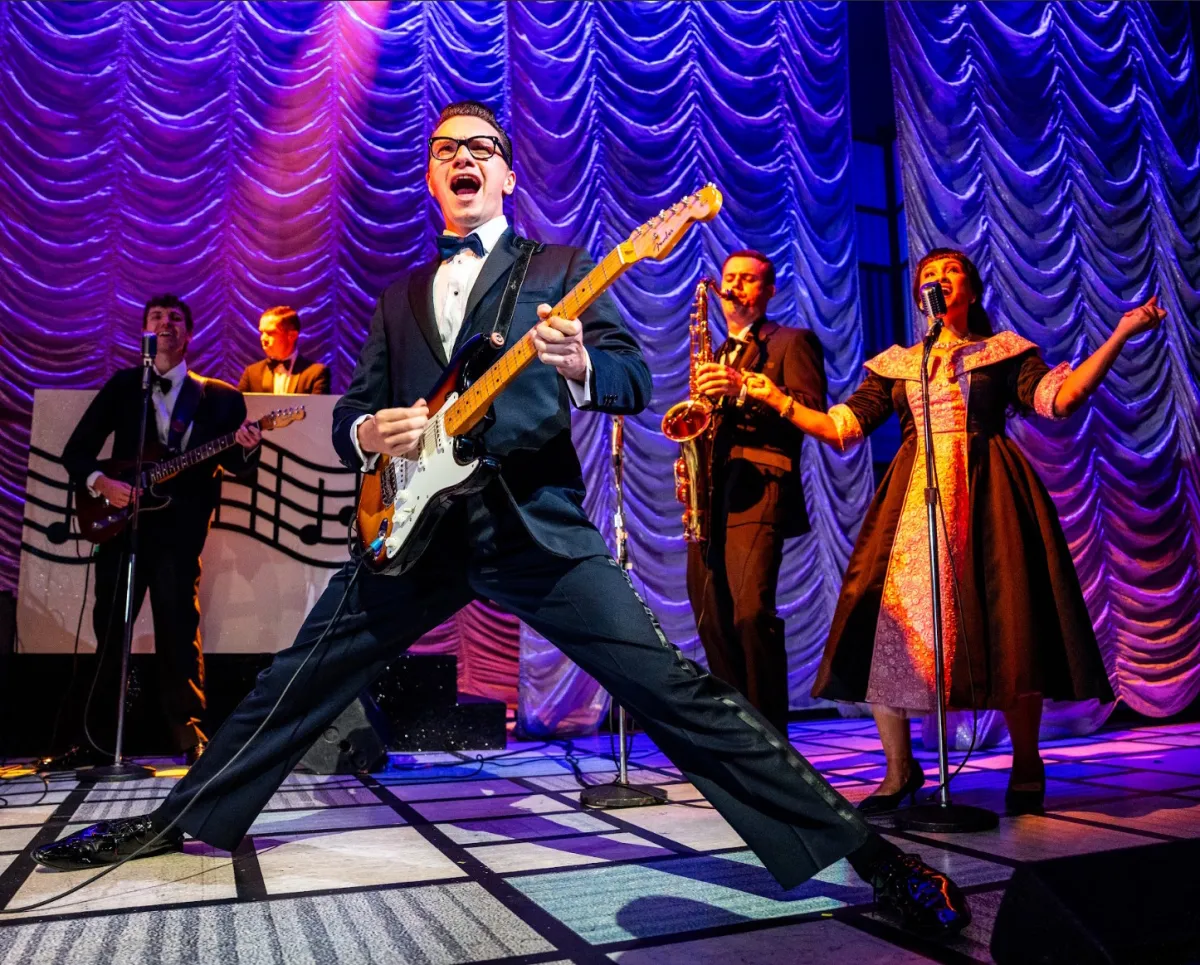
Buddy Holly is often remembered through iconic images: the glasses, the Fender guitar, the youthful face and the songs that helped define an emerging musical revolution.
But “True Love Ways” complicates that familiar picture.
It reminds us that behind the rock ’n’ roll legend was a young man experiencing enormous changes in his personal life.
He had fallen in love.
He had married.
He was expanding musically.
He was thinking beyond the boundaries that had initially made him famous.
In that sense, “True Love Ways” does not merely show us who Buddy Holly was.
It hints at who he might have become.
That may be the greatest source of its emotional power.

More Than Six Decades Later, The Voice Is Still There
Technology changes.
Musical fashions disappear.
Generations grow older and pass their favorite records to their children and grandchildren.
Yet certain performances refuse to belong entirely to the past.
“True Love Ways” is one of them.
When Buddy’s voice enters, the distance between 1958 and the present suddenly feels smaller. For a few minutes, the tragedy has not happened yet.
He is still 22.
He is still newly married.
The studio lights are still glowing.
The musicians are still waiting for their cues.
And somewhere beyond those studio walls lies an apparently endless future.
That future never arrived.
But the recording did.
Perhaps that is why “True Love Ways” remains so haunting. We are not simply listening to a famous musician who died young.
We are hearing a young man singing about lasting love at a moment when he had every reason to believe that life was only beginning.
Buddy Holly could not know what waited just a few months ahead.
He only knew what he felt in that moment.
And more than six decades later, that feeling is still alive every time the record begins to play.
