THE WESTERN THAT CHANGED EVERYTHING: WHY LONESOME DOVE STILL HAUNTS AUDIENCES DECADES LATER
THE WESTERN THAT CHANGED EVERYTHING: WHY LONESOME DOVE STILL HAUNTS AUDIENCES DECADES LATER
Some Westerns are remembered for their gunfights. Others survive in the imagination because of sweeping landscapes, dusty towns, horseback chases, or larger-than-life heroes.
But every once in a while, a Western arrives that feels different.
It does not simply tell a story about the frontier. It feels like a farewell to the frontier itself.
That is the enduring power of Lonesome Dove.
When the four-part CBS miniseries premiered in February 1989, audiences were introduced to a version of the American West that was far removed from the clean mythology of traditional cowboy stories. There were no simple heroes riding into the sunset, no easy victories, and no promise that courage alone could protect a man from fate.
Instead, viewers entered a world where friendship could last for decades, dreams could disappear overnight, and even the strongest men eventually had to confront the limits of their own mortality.
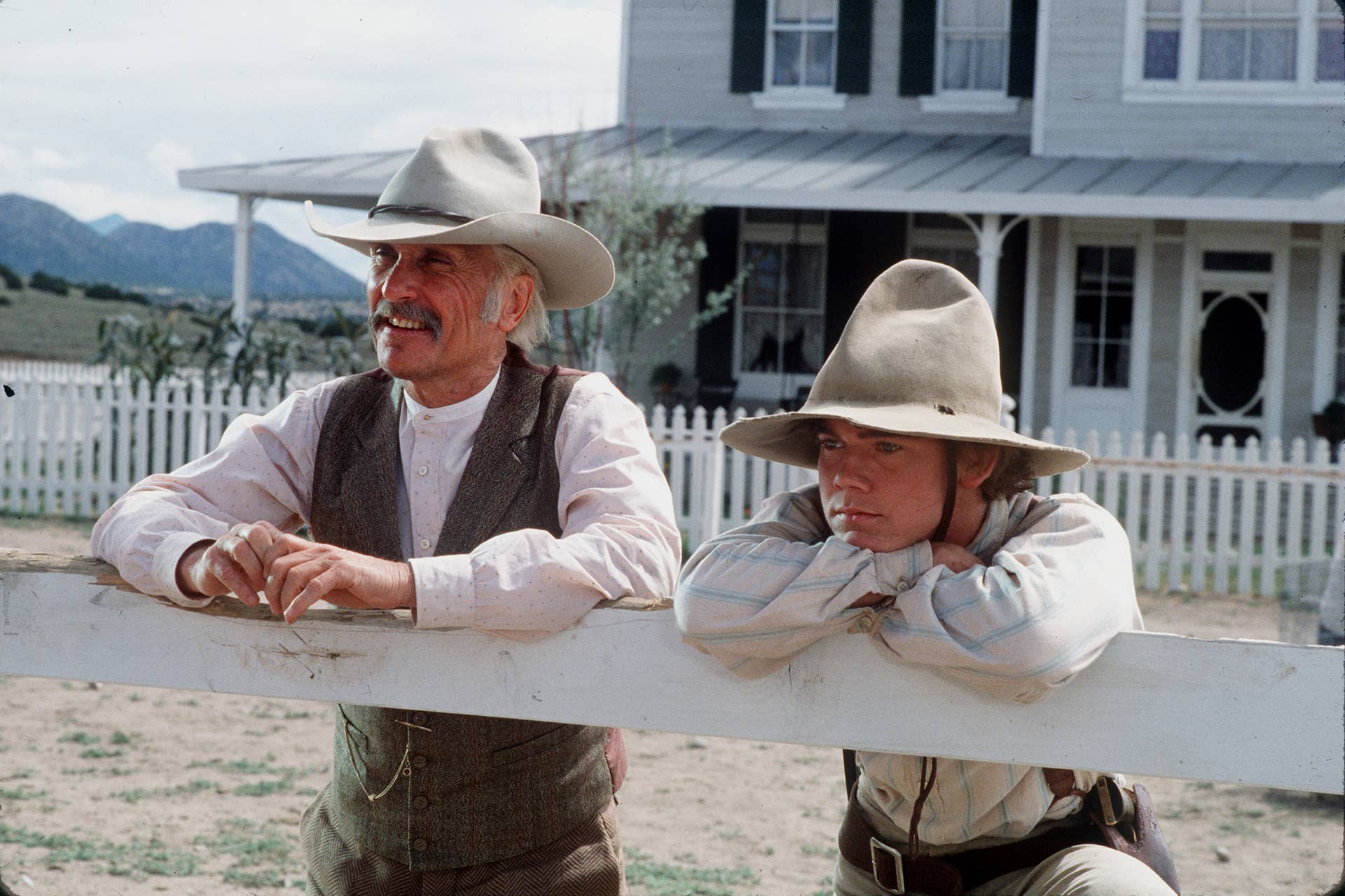
At the center of that world were two former Texas Rangers: Augustus “Gus” McCrae, played by Robert Duvall, and Woodrow F. Call, portrayed by Tommy Lee Jones.
They could hardly have been more different.
Gus was charming, talkative, unpredictable, and endlessly fascinated by women, adventure, and the strange possibilities of life. Call was disciplined, stubborn, reserved, and almost incapable of expressing emotions that Gus seemed to understand instinctively.
Yet somehow, the two men worked.
Their friendship became the emotional foundation of the entire story.
The journey begins when they decide to drive a herd of cattle from Texas toward Montana. On paper, it sounds like the kind of grand adventure that Western audiences had seen countless times before.
But Lonesome Dove quickly reveals that the cattle drive is only the surface.
The real journey is about two aging men attempting to understand what their lives have become.
For Call, the expedition represents movement, purpose, and perhaps an opportunity to escape the feeling that the world is changing around him. For Gus, it is another chance to experience life before the curtain finally comes down.
Neither man knows exactly what waits at the end of the trail.
That uncertainty gives the story much of its emotional weight.
Unlike many traditional Westerns, Lonesome Dove does not treat the frontier as a playground where men can reinvent themselves without consequences. The wilderness is beautiful, but it is also indifferent. Rivers can kill. Weather can destroy plans. Violence can arrive without warning.
And death does not care whether a person is brave, experienced, young, or old.
This realism makes the characters feel unusually human.
Gus, in particular, became one of the most memorable figures in Western storytelling because he refuses to behave like a conventional hero. He jokes when others expect seriousness. He flirts when circumstances seem inappropriate. He drinks, laughs, argues, and occasionally makes reckless decisions.
But beneath all that humor is an extraordinary awareness of life.
Gus understands that the moments people remember are often the small ones.
A conversation around a campfire.
A joke between old friends.
A glance exchanged between people who have known each other for years.
A quiet evening beneath an enormous sky.
Those moments become increasingly important because the story constantly reminds the audience that they cannot last forever.
Woodrow Call provides the perfect contrast.
Where Gus embraces life, Call tries to control it.
He believes in discipline. He believes in completing a mission. He believes that emotional weakness must be suppressed. Even when surrounded by people who care about him, Call often struggles to communicate what he truly feels.
That difference between the two men creates one of the story’s deepest questions:
What does it mean to live a meaningful life?
Is it better to remain disciplined and focused on duty, or to embrace pleasure, friendship, romance, and uncertainty while there is still time?
Lonesome Dove never offers an easy answer.
Instead, it allows both men to embody different possibilities.
Their friendship is powerful precisely because neither completely understands the other.
Gus can see through Call’s toughness.
Call, despite his silence, remains deeply connected to Gus.
They argue constantly, challenge each other, and sometimes seem almost incapable of agreeing on anything.

Yet when the moment comes, each man knows exactly where the other stands.
That kind of loyalty is rare in Western stories.
The miniseries also succeeds because it gives the supporting characters enough depth to make the world feel enormous. Cowboys, settlers, outlaws, women, lawmen, drifters, and travelers all seem to carry their own histories.
Nobody exists merely to decorate the background.
Every person appears to be moving toward something.
Some are searching for freedom.
Others want money.
Some want love.
Others want revenge.
And some simply want to survive another day.
That complexity is part of what separates Lonesome Dove from conventional Western adventure.
The landscape itself becomes almost another character.
The enormous skies, open plains, rivers, forests, and mountains create an overwhelming sense of scale. The characters appear small against the environment, emphasizing the idea that the frontier was never truly under human control.
Even the most experienced cowboy is still vulnerable to nature.
The visual beauty therefore carries a darker meaning.
The West may look magnificent, but it is also disappearing.
That sense of disappearance is perhaps the most important theme in Lonesome Dove.
The characters are living during a period when the legendary frontier is beginning to change. Civilization is advancing. New towns are appearing. Old ways of life are becoming increasingly difficult to maintain.
The cowboy myth is slowly becoming history.
And Gus and Call seem to understand that, even when they refuse to say it.
This is why the story feels less like a celebration of the Old West and more like a mournful farewell to it.
The title itself carries that melancholy.
Lonesome Dove suggests a place that is isolated, temporary, and vulnerable to change. The characters are constantly moving through spaces that feel as though they are already slipping away.
By the time the journey reaches its later stages, the audience realizes that the destination was never the most important part.
The road was.
The conversations were.
The arguments were.
The friendships were.
The memories created along the way were.
And that may explain why the miniseries continues to resonate with audiences decades after its original broadcast.
People do not remember Lonesome Dove simply because it contains cowboys and cattle.
They remember it because it understands something universal.
Every journey eventually ends.
Every friendship changes.
Every generation eventually gives way to another.
And even the strongest people eventually discover that there are things they cannot outrun.
Robert Duvall’s Gus McCrae became unforgettable because he seemed determined to squeeze every possible drop of life from his remaining years. Tommy Lee Jones’ Woodrow Call represented the opposite instinct: keep moving, keep working, keep fighting, and never stop long enough to confront what lies beneath the surface.
Together, they created one of television’s most enduring partnerships.
Lonesome Dove did not need to reinvent the Western through louder gunfights or bigger action sequences.
It did something much harder.

It made the Western deeply human.
It showed that behind every legend was a person.
Behind every heroic reputation was a collection of regrets.
Behind every great journey was the possibility that someone would not make it home.
And behind every fading frontier was a generation of people who had no idea they were living through the final chapter of an era.
That is why Lonesome Dove still feels so powerful.
It is not merely a story about the Old West.
It is a story about friendship, aging, ambition, loss, memory, and the terrible beauty of knowing that nothing lasts forever.
Some Westerns end when the shooting stops.
Lonesome Dove keeps echoing long after the final ride.
