🔥🏹 ONE MAN AGAINST AN ENTIRE SEARCH PARTY — AND THE FOREST IS ON HIS SIDE.
When we watch First Blood (1982) today, almost four decades years after it was first released and having had our thoughts coloured by three sequels and countless copycats, and the career trajectory of its star Sylvester Stallone, we are faced with a contradiction of sorts. On the one hand you have the John Rambo we all think of when we hear his name, the fighter, the warrior, the Reagan-era American hero. As Colonel Trautman explains, Rambo is “… an expert in guerrilla warfare, a man who’s the best, with guns, with knives, with his bare hands. A man who’s been trained to ignore pain, ignore weather, to live off the land, to eat things that would make a billy goat puke. In Vietnam his job was to dispose of enemy personnel. To kill! Period! Win by attrition. Well Rambo was the best.”
Yet this is not the John Rambo we are introduced to at the beginning of the first of this series of films. He’s a Vietnam veteran who now has difficulty holding down a job, a wanderer who doesn’t fit in anywhere and who can’t settle down. At the start of the movie we are introduced to him at his most hopeful as he walks down a country road looking for his old friend and fellow member of Baker Team, Delmar Berry. For a man who, as we’ll discover, uses very few words, here he is at his most animated, experiencing a combination of high emotion and memories of his old team (the closest he ever got to a family). The only other time he would be so open is at the climax when he is cornered, both physically and mentally, in the police station and once again he allows the trauma and the loss to be revealed, to affect him emotionally. These two scenes act as bookends to the silent stoic type we usually associate with John Rambo.
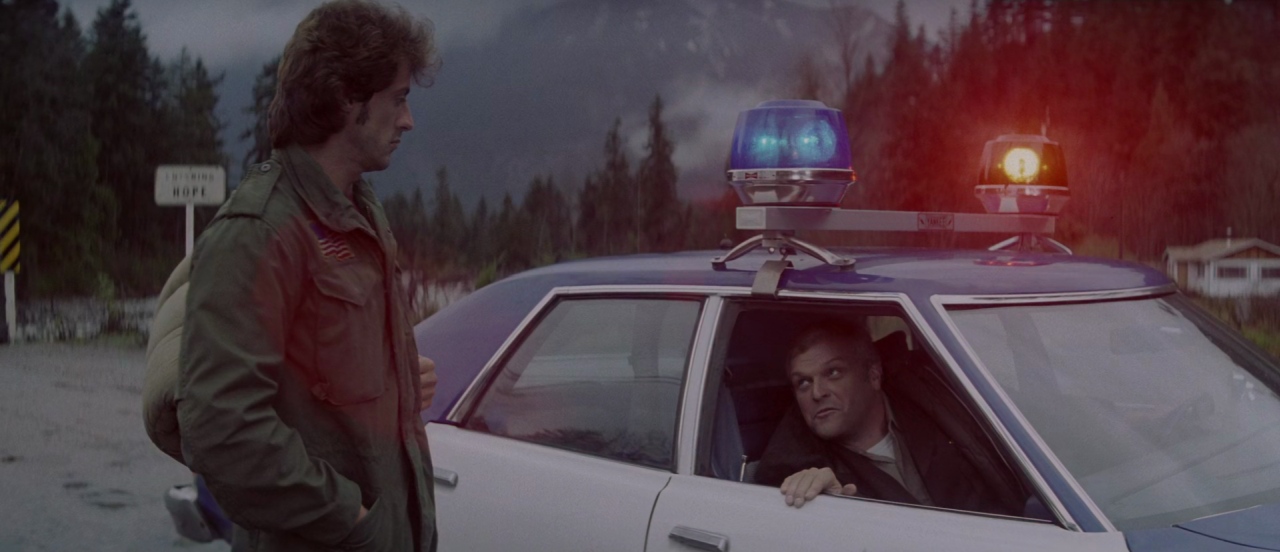
Unfortunately Delmar is dead, just like the rest of his platoon. He returned from ‘Nam with cancer caught from, we suspect, Agent Orange. “Got himself killed in ‘Nam, didn’t even know it. Cancer ate him down to the bone.”
On finding out about his friend’s death something dies in Rambo. It is at this point, early in the film that Rambo becomes the silent anti-hero we remember him as. He is angry and lost and the last thing he needs is for someone to push him. Then he meets Brian Dennehy’s Sherriff Teasle, who of course pushes him.
Teasle is a no nonsense sheriff whose motives are discussed numerous times throughout the film but are, ultimately, open to debate. Is he just doing his job? Does he pick on Rambo because he is a vagrant? Because he is a Vietnam vet? He explains himself a number of times although these attempts at justifying his treatment of Rambo are often defensive – “Dammit, Dave, you think this kid just waltzed into town, announced he was a Medal Of Honour winner, and then I just leaned on him for the hell of it? I tried to do him a favour, I treated him like he was one of my neighbour’s kids. I did my job Dave, I booked him for vagrancy and resisting arrest’.” What is obvious is that Teasle does not want Rambo in his town but, unfortunately for Teasle, he picks on the wrong man on the wrong day.
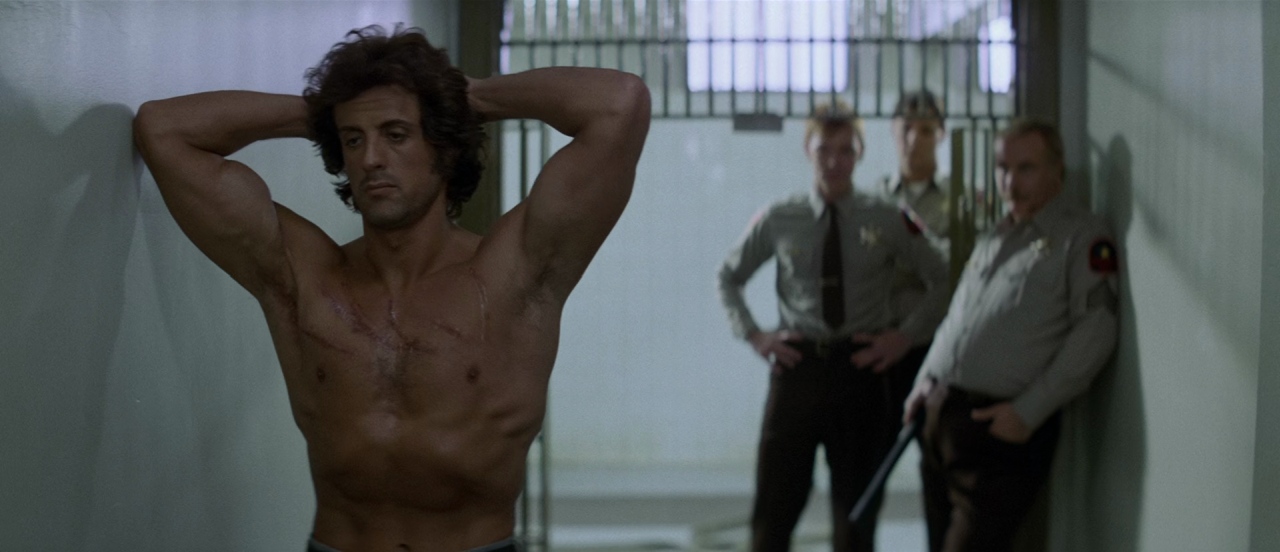
Rambo is dropped off on the outskirts of town with one simple instruction – keep going. Rambo doesn’t listen, turns around and heads back into town. At this point Teasle has put himself into a corner and has no choice but to arrest the wanderer for vagrancy and it is in the police station we glimpse the depth of Rambo’s emotional problems and the post-traumatic distress disorder he is suffering from. As the police manhandle him he has flashbacks to the torture he endured at the hands of the Viet Cong. The bars on the police cell become the bamboo bars of his Vietnamese cell, the shouting cop becomes a Viet Cong barking insults at his prisoner of war.
It’s easy in hindsight to only think of Rambo as the one-dimensional action hero he would become with each sequel, but in First Blood he is more than that, he is damaged and afraid. He wants to fit in but can’t and, because he can’t, people will not let him. The only way he knows how to react when faced with this perceived threat is to revert to his training and his expertise and fight back.
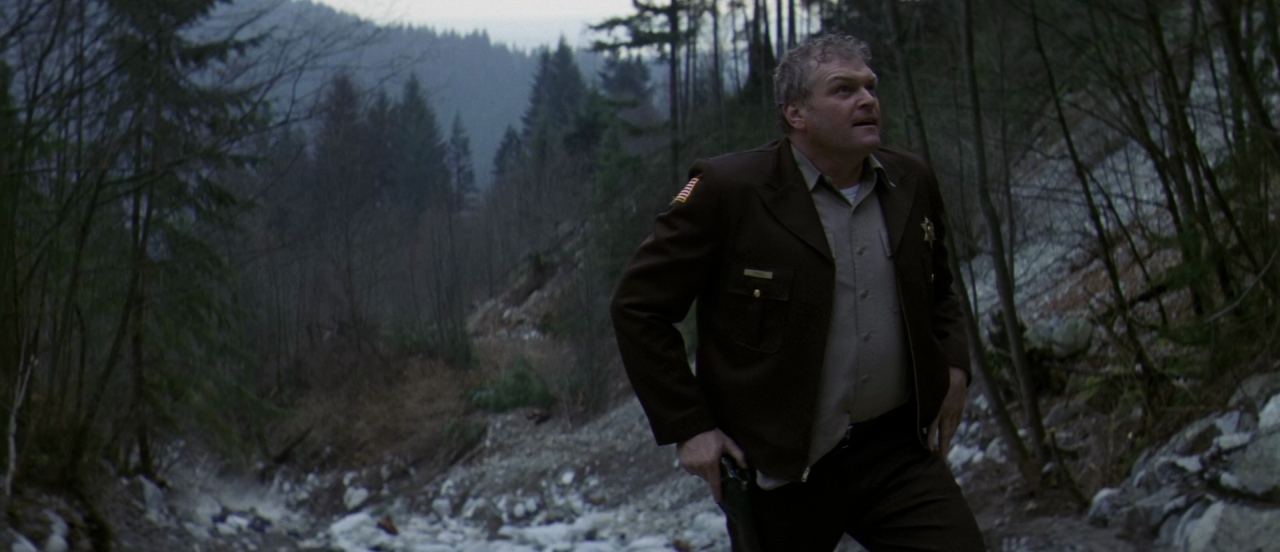
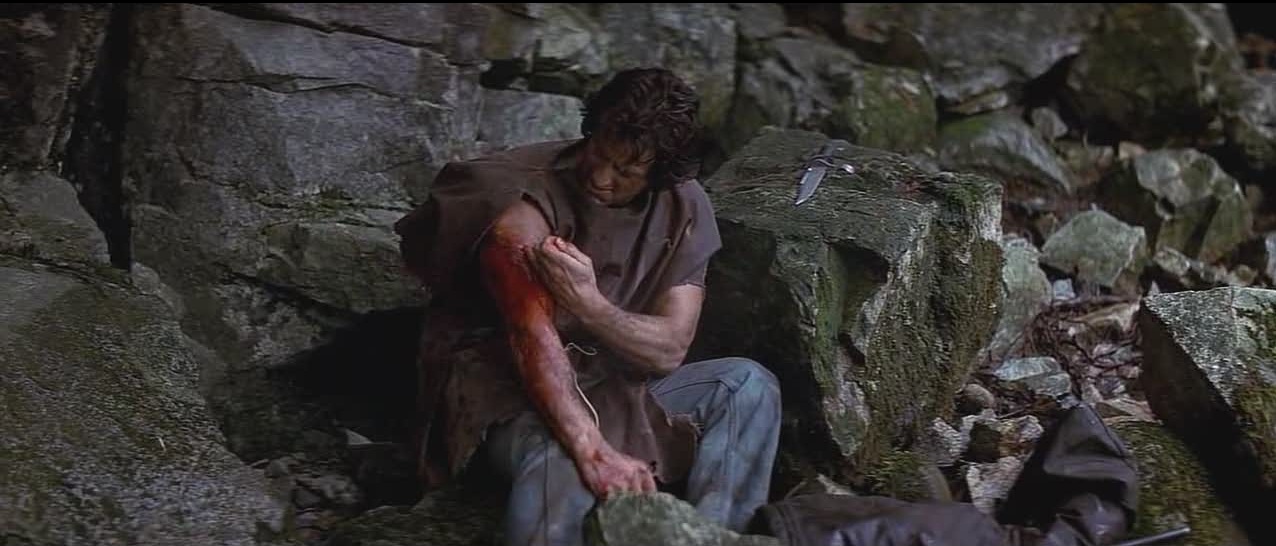
The extent that Rambo will go to survive is perfectly illustrated early on in the mountain when the police are in pursuit, a cop in a helicopter is shooting at him and the only way he can escape is to jump off a cliff. There is no stoic heroism in his eyes only fear – fear of getting caught, of being shot and of certain injury, yet he still jumps, ignoring the possibility of death. Director Ted Kotcheff and the stunt doubles do not try to hide the folly in this. Each branch of the tree Rambo hits on the way down obviously hurts as he grunts and cries out in pain. On the ground he holds his arm and grimaces in agony. Yet he can still sow himself up without any antiseptic or something to numb the pain. Later, as he makes his way through the cave, rats crawl up his back and start biting his neck. Again it is evident he’s a lot of pain and pulls the rats off in anguish and disgust. It reminds me of a very similar scene in Indiana Jones and the Last Crusade when, deep beneath the streets of Venice, Indy nonchalantly picks up a rat and discards it as the woman screams; the threat the rats pose is played for comic value. Indiana Jones is about heroism, First Blood is about survival.
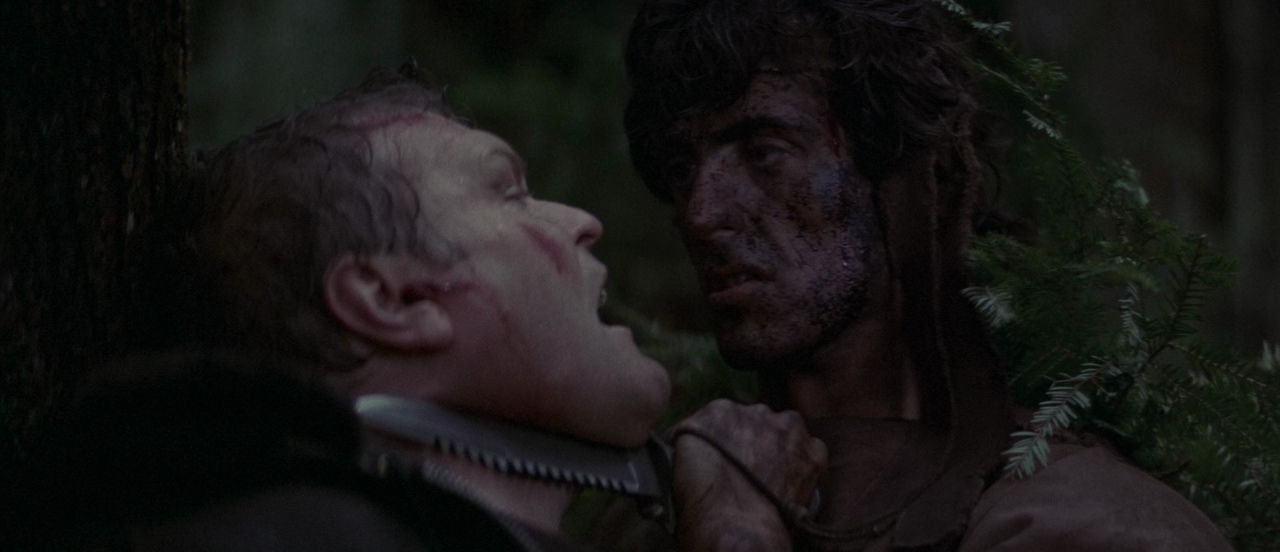
It is here we are introduced to Rambo’s commanding office Colonel Trautman played by Richard Crenna, as straight laced as possible. There’s a feeling that Trautman can’t be trusted, he now sits behind a desk in Washington, a bureaucrat, instead of the man who trained and led Rambo in battle. In some ways this turns out to be the case later when the Colonel offers to help turn his man in. Yet no one knows or understands Rambo better than Trautman. It’s to Trautman who Rambo confesses of his inability to cope with civilian life. The soldier needs his commanding officer; he needs the structure of the army. As Rambo says in that climatic scene;
“For me civilian life is nothing! In the field we had a code of honour, you watch my back, I watch yours. Back here there’s nothing!”
It’s in this final scene that Rambo gives us the second glimpse into the trauma he endured. He and his friend Joey were in a bar in Siagon when a child offers to shine their shoes. Rambo goes off to get a drink but Joey stays and says yes. The shoe-shine box is wired and a bomb goes off and Joey’s body is blown all over Rambo – “I’m tryin’ to pull him off, you know, my friend that’s all over me! I’ve got blood and everything and I’m tryin’ to hold him together!’” Worse still, there’s a premonition of what was to come in the civilian world – “Nobody would help!”
 He was alone then and he is alone now: “I can’t get it out of my head. A dream of seven years. Every day I have this. And sometimes I wake up and I don’t know where I am. I don’t talk to anybody. Sometimes a day – a week.”
At the end of Taxi Driver, another film about a Vietnam veteran who goes on a destructive rampage, Travis Bickle is hailed as a hero for saving a young prostitute and disposing of low-life pimps. At the end of First Blood John Rambo is arrested and escorted away by the police for, we would assume, a very long stint in prison.
Once it gets going, director Ted Kotcheff’s film zips along at a pace that scarcely allows you to catch your breath but is also full of moments of poignant reflection on the suffering a generation of young men abandoned by a country that failed to recognise the sacrifice they made in a war, that ultimately no one wanted. Whilst First Blood often gets lumped in with its many one dimensional action film counterparts, it’s anything but a straightforward action film. Kotcheff’s film has depth and nuance and a strong vein of important social commentary. It’s protagonist isn’t the invulnerable super-soldier he’d later come to be. He’s tortured (both literally and figuratively) and bears scars both physical and psychological.
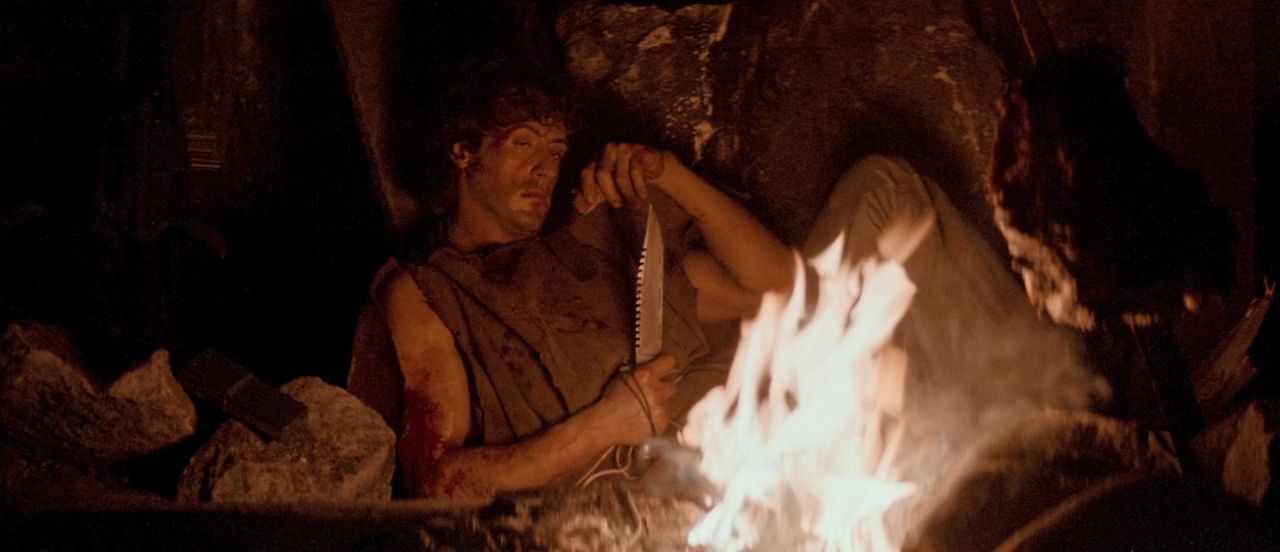
Stallone hasn’t always received the credit he deserves for his acting abilities and First Blood is up there with his very best performances. When backed into a corner he’s lethally efficient but we are always able to see the vulnerability beneath the surface. He may be the protagonist but he’s also the victim of some less than welcoming treatment from the small town’s police. But even Brian Dennehy’s Sheriff Teasle is a well defined character and not your typical bad cop with a vendetta. He wants to maintain law and order and cares for his men in spite of his woefully poor judgment and subsequent treatment of Rambo.

It’s good sometimes to go back to the start of a series, to watch with new eyes and try to recapture those impressions that we had at the time but which have slowly changed over the decades as we have changed ourselves. We do not think of Rambo as a man who suffers, we think of him as a lethal killing machine. We think of the Rambo: First Blood Part II poster which emphasises brawn and muscle over vulnerability. Yet here he is, at the start of his story, a man all alone in a world that’s rejected him and he’s not able to do anything about it other than fight back against the oppressive establishment that didn’t heed his warning not to push him. Maybe it’s a film that’s now more prescient and relevant than ever.