BUDDY HOLLY’S QUIETEST CONFESSION: THE SONG THAT REVEALED A SIDE OF HIM FEW EVER SAW
BUDDY HOLLY’S QUIETEST CONFESSION: THE SONG THAT REVEALED A SIDE OF HIM FEW EVER SAW
There was another side to Buddy Holly that could easily disappear beneath the noise of early rock and roll.
To the public, he was the young man with the unmistakable glasses, the distinctive voice, and a string of recordings that helped reshape popular music. He represented movement, youth, experimentation, and the restless excitement of a generation discovering a new sound.
But sometimes, the most revealing moments came when all of that energy disappeared.
In 1958, Holly recorded “Look at Me,” a song that offered a much more intimate glimpse into the person behind the performer. Rather than relying on the explosive attitude associated with rock and roll, the recording carried an emotional restraint that made it feel almost like a private conversation.
It was not simply another love song.
It sounded like someone looking inward.
And that is precisely what makes “Look at Me” so fascinating decades later.

THE VOICE BEHIND THE GLASSES
Buddy Holly’s image became inseparable from his music.
Those thick-rimmed glasses, once an ordinary necessity, eventually became one of the most recognizable symbols of early rock and roll. His appearance suggested confidence and individuality, while his recordings demonstrated an artist who was constantly willing to experiment.
Yet the public image never completely explained the person.
Holly’s music could be energetic and playful, but it could also be vulnerable. Beneath the catchy melodies and rhythmic drive was an artist capable of expressing uncertainty, affection, disappointment, and loneliness with remarkable simplicity.
“Look at Me” belongs to that quieter part of his musical personality.
There is no need for theatrical drama. The emotional weight comes from the feeling that the singer is examining his own mistakes and wondering what they have cost him.
The central idea is painfully human: after hurting someone, after making mistakes in love, can a relationship still survive?
That question gives the song an unusual intimacy.
Instead of presenting heartbreak as something glamorous, Holly approaches it as something deeply personal.
WHEN ROCK AND ROLL BECAME PERSONAL
The late 1950s were filled with songs designed to capture excitement.
Rock and roll was young, rebellious, loud, and unpredictable. Artists were creating new sounds while audiences were discovering a style of music that felt dramatically different from what had dominated earlier decades.
Buddy Holly was one of the musicians helping build that new musical world.
But he also understood that not every emotion required volume.
“Look at Me” demonstrates that an artist could participate in the rock and roll revolution while still creating music built around vulnerability rather than rebellion.
That contrast is important.
Holly did not need a wild performance to communicate emotional tension. A restrained vocal could sometimes say more than an explosive one.
The song’s strength comes from its simplicity. The listener is not overwhelmed by elaborate storytelling. Instead, the focus remains on the emotional question at its center.
That makes the recording feel almost timeless.
A SONG THAT SOUNDS LIKE A MIRROR
The title itself suggests an act of self-examination.
“Look at Me” can be heard not only as a plea directed toward another person but also as an invitation to confront one’s own reflection.
That interpretation gives the song another layer.
Imagine the young musician stepping away from the spotlight, away from screaming audiences and recording sessions, and asking himself what remains when the performance ends.
That is where the song becomes especially powerful.
The glamorous image of a rising rock-and-roll star disappears. What remains is a young man wrestling with the uncertainty that comes with love.
There is something almost uncomfortable about that honesty.
Fame does not eliminate insecurity.
Success does not guarantee happiness.
And being surrounded by people does not necessarily protect someone from loneliness.
Holly’s ability to communicate those contradictions is one reason his music continues to connect with listeners.

THE SENSITIVE SIDE OF A ROCK AND ROLL PIONEER
It is tempting to remember Holly primarily through his greatest achievements.
He helped establish the importance of the singer-songwriter in popular music. His recordings influenced musicians who came after him, and his work with the Crickets became part of the foundation upon which later rock music was built.
But reducing Holly to an innovator misses something essential.
He was also remarkably sensitive.
His songs frequently dealt with relationships, uncertainty, longing, and emotional vulnerability. Even when the arrangements were energetic, there was often a personal quality in his singing that made the material feel close to the listener.
“Look at Me” brings that quality to the foreground.
There is no larger-than-life character hiding behind the lyrics.
There is simply a person wondering whether love can survive disappointment.
That simplicity may be exactly why the song feels so intimate.
THE HUMAN BEING BEHIND THE LEGEND
Today, Buddy Holly is often discussed as a musical pioneer whose career was tragically brief.
His influence became enormous despite the fact that his life ended at only 22 years old. The February 1959 plane crash that took his life transformed him into one of rock music’s most enduring legends.
But knowing how his story ended can sometimes overshadow the music he created while he was still alive.
Songs such as “Look at Me” remind listeners that Holly was not simply a historical figure.
He was young.
He was ambitious.
He was experimenting.
He was falling in love, making mistakes, and trying to understand the complicated emotions that come with being human.
That perspective makes the recording even more poignant.
When listeners hear his voice today, they are hearing someone who never had the opportunity to grow old and show how his music might have changed with him.
Every intimate recording therefore carries an additional sense of fragility.
WHY “LOOK AT ME” STILL FEELS SO INTIMATE
More than six decades after its era, “Look at Me” remains interesting because it does not depend on spectacle.
There are no enormous musical gestures required to understand its emotion.
Instead, the song creates a small emotional space and invites the listener inside.
That restraint allows Holly’s personality to become more visible.
The young man who helped energize rock and roll suddenly feels less like an icon and more like someone sitting alone with difficult questions.
And perhaps that is the greatest strength of the recording.
It reminds us that behind every famous performer is a private individual with fears, hopes, regrets, and insecurities.
Buddy Holly may have become one of the defining figures of early rock music, but songs like “Look at Me” reveal why his legacy has never been limited to musical innovation.
There was warmth behind the image.
There was uncertainty behind the confidence.
And there was a deeply human voice behind those famous glasses.
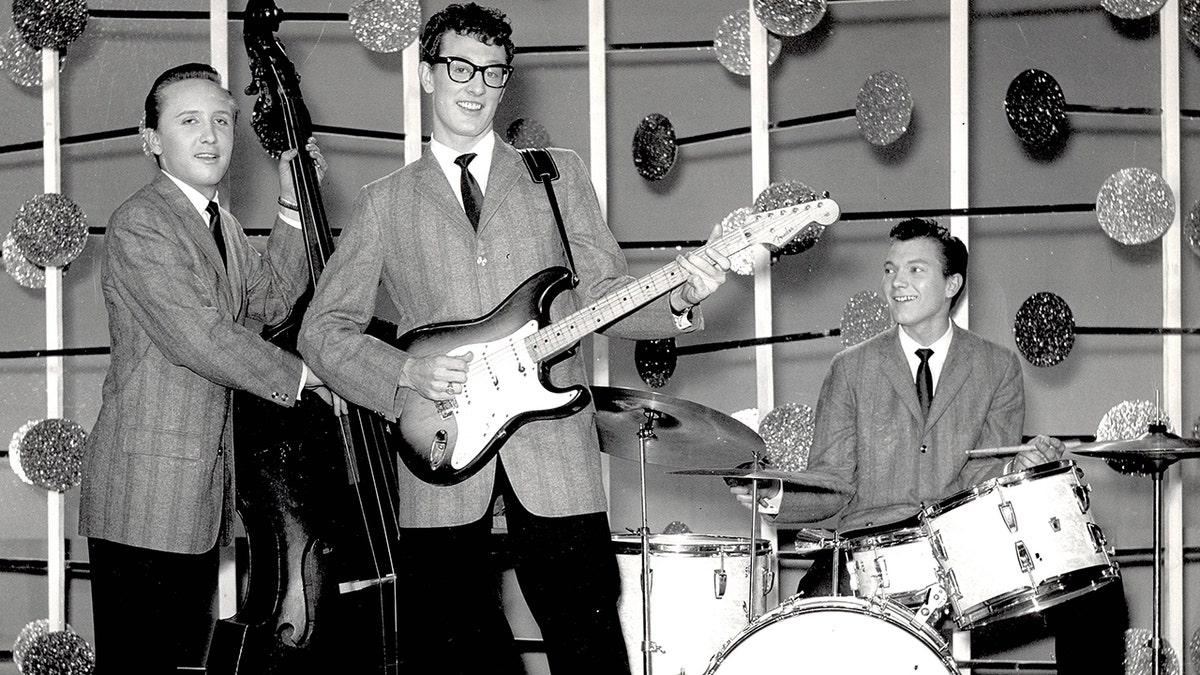
A FINAL GLIMPSE INTO BUDDY HOLLY’S HEART
Buddy Holly’s career was tragically short, but his recordings continue to offer new ways of understanding the person behind the legend.
“Look at Me” is especially memorable because it strips away much of the mythology.
For a brief moment, the pioneer disappears.
The rock-and-roll star becomes simply a young man asking whether love can survive mistakes and whether someone will stay when things become difficult.
That question is not limited to the 1950s.
It belongs to everyone who has ever regretted something they said, feared losing someone they loved, or wondered whether they were worthy of another chance.
Perhaps that is why the song still carries emotional power.
Buddy Holly left behind a musical legacy far larger than his years, but moments like this reveal something even more lasting: the legend mattered because there was a real human being underneath it all.
And sometimes, the quietest songs tell us the most.
