Danny Tommo Channel Confrontation Sparks Police Investigation
Danny Tommo Channel Confrontation Sparks Police Investigation
A dramatic confrontation in the English Channel has triggered widespread attention after footage appeared to show anti-migrant activist Daniel Thomas, known online as “Danny Tommo,” using a blade to slash an inflatable dinghy while a rescue worker was still onboard. Hampshire police have said they are conducting inquiries into the footage, while the incident has intensified an already heated debate over Channel crossings, protest tactics and the safety of rescue crews.
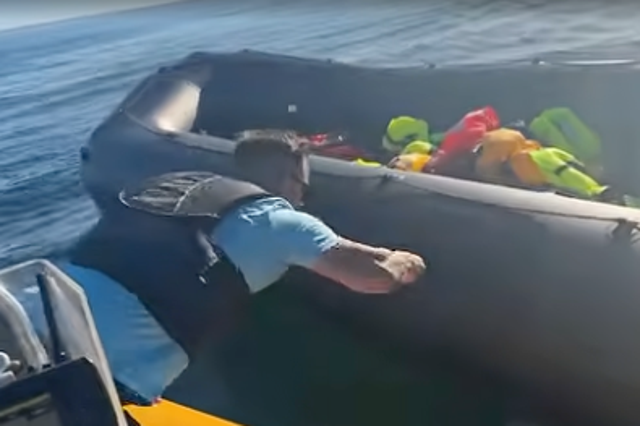
The incident unfolded on Tuesday, September 22, as Thomas was filming himself from a small speedboat while following two inflatable boats that had travelled from France towards the UK. The migrants aboard the boats were being assisted by rescue services, and the operation was taking place against the backdrop of a planned anti-migration demonstration in Gosport, Hampshire.
According to reports, Thomas approached one of the inflatable dinghies after the passengers had been transferred to rescue vessels. The abandoned boat contained numerous life jackets, indicating that people had recently been onboard. Thomas was seen approaching the vessel and announcing his intention to interfere with it.
The footage subsequently became the centre of the controversy.
Video streamed online appeared to show Thomas holding a knife or blade and repeatedly cutting into the side of the inflatable craft. Air could reportedly be heard escaping from the damaged vessel. During the confrontation, a rescue worker wearing high-visibility clothing and a helmet was onboard the dinghy.

Thomas was then heard telling the worker to leave the boat. The footage showed his speedboat moving away shortly afterward, while the rescue worker returned towards the larger rescue vessel. The available video does not establish every detail of what happened before or after the moment captured on camera, which is one reason police inquiries remain important.
The incident has attracted strong criticism from organisations involved in refugee and migrant issues. The Joint Council for the Welfare of Immigrants described the behaviour as dangerous, while other campaign groups also condemned the footage. The criticism has focused particularly on the presence of a rescue worker at the time the inflatable boat was damaged.
The police investigation adds another significant dimension. Hampshire and Isle of Wight Constabulary confirmed that officers were conducting inquiries into the footage showing a rescue worker on the boat while it was being slashed. At the same time, officers were dealing with a separate protest in Gosport connected to the expected arrival of asylum seekers.
Six people were arrested during the wider events surrounding the Gosport protest. According to police, two men from Salisbury were arrested on suspicion of aggravated trespass. Four people from Gosport were arrested on suspicion of assaulting an emergency worker, while one of those individuals also faced an allegation of careless driving.
The arrests demonstrate how quickly tensions around Channel migration can move beyond political demonstrations and into confrontations involving emergency services and police.
The Gosport protest had been organised around the expectation that asylum seekers rescued at sea would arrive in the area. However, the Border Force vessels ultimately transported the rescued people to Dover rather than Gosport. Hundreds of protesters had gathered in anticipation of their arrival, creating a major police operation around the marina.
Thomas had reportedly spent the afternoon at sea tracking small boats before travelling back towards the area of the protest. His activities were livestreamed to a large online audience, with reports saying more than 100,000 people watched the broadcast. The use of livestreaming meant that the confrontation was quickly distributed across social media and became part of a much wider political argument.
The incident also comes after several weeks of increasingly visible protests over small-boat crossings. Thomas has been associated with the Patriot Platform, an anti-migration group that has organised demonstrations and maritime activities intended to disrupt or draw attention to migrant crossings.
Earlier in September, large protests took place in Portsmouth following the arrival of a boat carrying around 140 asylum seekers. Hundreds of demonstrators gathered, and police were required to manage road blockages and breaches of police cordons. Thomas was among the activists involved in the protests and used livestreaming to document events.
The latest confrontation therefore did not occur in isolation. It followed a period of heightened tension in coastal communities, where debates about migration have increasingly intersected with protests, policing and rescue operations.
For emergency workers, the central concern is safety. The RNLI and other rescue organisations operate in difficult conditions and are responsible for assisting people whose lives may be at risk at sea. Any additional confrontation involving rescue vessels can create complications for crews who are already dealing with unpredictable weather, damaged boats and vulnerable passengers.

Reports surrounding the September 22 incident stated that the migrants involved had spent many hours at sea before being rescued. The RNLI said the people had been in the water for around 36 hours, a particularly prolonged period for a Channel crossing.
That detail highlights the wider humanitarian and operational challenge facing rescue services. Regardless of political views about immigration policy, crews responding to distress calls have to deal with immediate questions of survival and safety.
At the same time, the incident has become part of a political dispute about the UK’s migration system. Supporters of tougher border controls argue that small-boat crossings must be reduced and that government policy has failed to prevent dangerous journeys. Critics of anti-migration protests argue that confronting rescue operations risks creating additional danger without addressing the underlying causes of the crossings.
The government continues to face pressure over Channel migration, while Border Force, the RNLI, French authorities and other agencies remain involved in responding to boats travelling across the Channel.
The controversy surrounding Thomas also illustrates how social media has transformed political activism. A confrontation that once might have been witnessed by a handful of people can now be livestreamed to tens of thousands of viewers within minutes. Footage can then be reposted, edited and discussed across multiple platforms, often before authorities have completed their investigations.
That creates a difficult environment for distinguishing confirmed information from commentary. The footage itself has become central evidence for public discussion, but its interpretation remains a matter for investigators and, where appropriate, courts. Police have not announced a final conclusion regarding any potential offences arising from the incident.
Thomas has continued to comment publicly on the events. LBC reported that he described the episode as a “sad day” after his attempt to prevent a migrant dinghy from reaching the UK did not succeed.
His supporters may view his actions as part of a campaign against illegal Channel crossings, while critics have described the use of a blade around a rescue operation as unacceptable. Those are competing political and moral interpretations of the same event.
What remains clear is that the confrontation has increased scrutiny of activist behaviour at sea. The presence of emergency workers makes such incidents particularly sensitive because rescue operations depend on cooperation, communication and safe access to vessels.
The investigation by Hampshire police will therefore be closely watched. Authorities will need to establish precisely what occurred, the sequence of events and whether any criminal offences were committed. Until that process is complete, claims about possible charges or motives should be treated carefully.

The wider political debate is unlikely to disappear. Channel crossings remain one of Britain’s most controversial political issues, while communities along the southern coast continue to experience protests and increased police activity.
For now, the Danny Tommo incident stands as another highly visible episode in that continuing dispute. The footage has generated intense reaction, but the most important questions concern safety, accountability and the facts established by the investigation.
As authorities examine the video and the surrounding circumstances, the incident will remain a focal point in Britain’s broader argument over migration and border control. Whatever conclusions eventually emerge, the confrontation demonstrates how quickly tensions surrounding the Channel can escalate when political activism, rescue operations and social-media broadcasting collide.
