THE NIGHT A 21-YEAR-OLD BUDDY HOLLY WALKED ONTO ED SULLIVAN — AND QUIETLY REWROTE THE FUTURE OF ROCK & ROLL
THE NIGHT A 21-YEAR-OLD BUDDY HOLLY WALKED ONTO ED SULLIVAN — AND QUIETLY REWROTE THE FUTURE OF ROCK & ROLL
There was no leather-clad swagger, no carefully manufactured bad-boy image, and none of the theatrical rebellion that many Americans were beginning to associate with rock & roll.
Instead, when Buddy Holly appeared on The Ed Sullivan Show on January 26, 1958, television viewers saw a slender 21-year-old from Lubbock, Texas, wearing his unmistakable thick-framed glasses and holding an electric guitar.
Then the music started.
Within moments, appearances became irrelevant.
Buddy Holly and The Crickets launched into “Oh, Boy!” with the kind of youthful urgency that helped define an emerging generation. The performance was brief, energetic, and deceptively simple. Yet viewed decades later, it feels like much more than another television appearance by a successful young singer.
It looks remarkably like a glimpse into rock music’s future.
A Different Kind of Rock Star
By early 1958, rock & roll had already produced larger-than-life personalities. Elvis Presley had transformed popular culture with his voice, looks, movement, and rebellious appeal.
Buddy Holly represented something different.
He looked surprisingly ordinary compared with some of the genre’s most flamboyant stars. His glasses became part of his identity rather than something he tried to hide. His stage presence depended less on theatrical gestures and more on the music itself.
That contrast became part of his appeal.
Holly demonstrated that a young musician did not need to fit one particular image to command an audience. He could walk onstage looking almost like the quiet student sitting at the back of a classroom and still unleash music powerful enough to send teenagers into a frenzy.
On The Ed Sullivan Show, that contradiction was impossible to miss.
The young man looked polite.
The sound was anything but timid.
Then Came “Oh, Boy!”
“Oh, Boy!” was perfectly suited to Holly’s distinctive vocal personality. His phrasing, sudden hiccups, rhythmic confidence, and unmistakable Texas-inflected delivery gave the song an excitement that was difficult to imitate.
But the performance also showcased something bigger.
There was Buddy with his electric guitar, surrounded by a compact band built around guitar, bass, and drums. To modern viewers, that arrangement hardly seems revolutionary.
That is precisely the point.
The format became so deeply embedded in rock culture that it is easy to forget how influential groups like The Crickets were during the genre’s formative years.
Instead of placing a singer completely apart from anonymous backing musicians, Holly and The Crickets presented the idea of a recognizable band whose members created a unified sound.
In the years that followed, countless young musicians would adopt similar arrangements.
Among the most famous were four young men from Liverpool who eventually became The Beatles. Their admiration for Buddy Holly is well documented, and even the name “The Beatles” echoed the insect-themed identity of The Crickets.
What television audiences were witnessing in January 1958, then, was not simply another hit being promoted.
They were seeing a model that would become central to popular music.

The Glasses That Became an Icon
Holly’s appearance also carried an unexpected cultural significance.
At a time when popular entertainers were often expected to project carefully polished glamour, his heavy glasses might have seemed like an unlikely accessory for a rock star.
Holly turned them into something unforgettable.
Over time, those frames became inseparable from his image. Generations of musicians would discover that authenticity could be more compelling than conventional ideas of cool.
He did not need to transform himself into someone else.
Buddy Holly looked like Buddy Holly.
And somehow, that made him even more revolutionary.
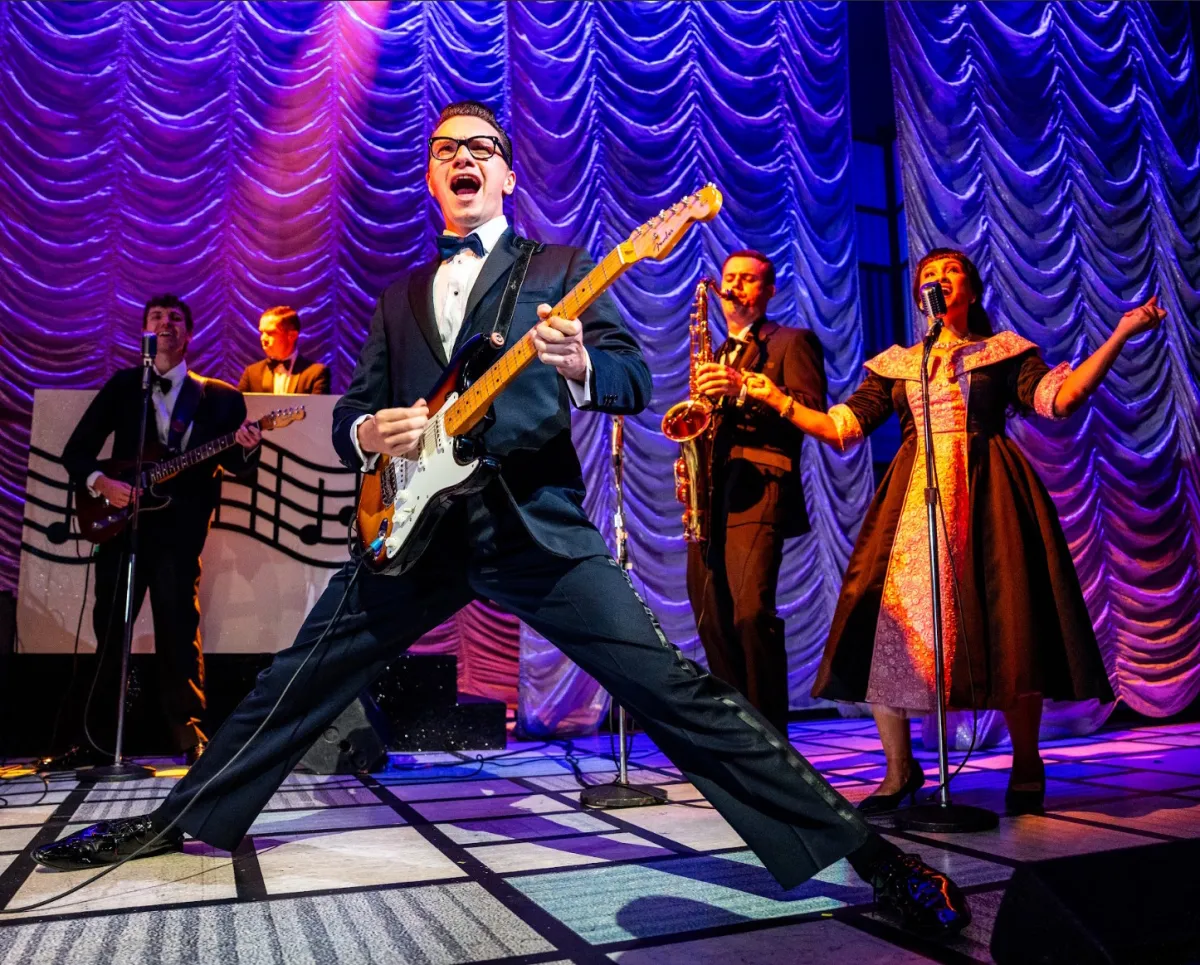
The image remains striking today: a young man behind thick lenses, gripping a Fender Stratocaster and producing music far more explosive than his appearance suggested.
The contrast became part of rock history.
Less Than Two Minutes, Decades of Influence
One of the extraordinary things about early rock & roll is how quickly its songs could make their point.
There was little wasted time.
“Oh, Boy!” explodes almost immediately into motion, carrying the listener through a rush of romantic excitement and youthful confidence before disappearing almost as quickly as it arrived.
Holly understood economy.
His recordings often contained memorable melodies, guitar hooks, vocal signatures, and emotional storytelling without requiring elaborate arrangements or extended performances.
That efficiency would influence generations of pop and rock musicians.
Write something unforgettable.
Play it with conviction.
Get out before the excitement fades.
The formula sounds simple. Achieving it is anything but simple.
A Performance Made More Haunting by History
Watching the performance today carries an emotional weight that viewers in 1958 could never have understood.
Buddy Holly appeared young, confident, and apparently standing at the beginning of an enormous career.
There was every reason to believe there would be decades of music ahead.
There weren’t.
Just over a year after that television appearance, Holly was killed in the February 3, 1959 plane crash near Clear Lake, Iowa, alongside Ritchie Valens and J.P. “The Big Bopper” Richardson. Pilot Roger Peterson also died.
Holly was only 22.
That knowledge changes the way archival footage feels.
Every smile becomes more precious. Every guitar chord seems more significant. Every television appearance becomes a surviving fragment of a career interrupted before anyone could know what its creator might eventually become.
Yet focusing exclusively on the tragedy risks overlooking the achievement.
Buddy Holly’s story is remarkable not simply because his life ended young.
It is remarkable because he accomplished so much before it did.

The Blueprint Was Already There
Holly helped demonstrate how songwriting, singing, guitar playing, and a self-contained band identity could exist together within rock & roll.
That combination would become increasingly important during the 1960s.
Bands would no longer simply perform songs handed to them while standing behind a featured vocalist. More musicians began writing their own material, developing recognizable group identities, and experimenting with what could happen when the performers themselves became creative forces.
Holly had already been moving in that direction.
His influence later stretched far beyond a single genre or generation. The Beatles, Bob Dylan, The Rolling Stones, and many others emerged in a musical world that Holly had helped shape.
The fascinating part is how little spectacle was required.
No giant stage.
No elaborate production.
No modern visual effects.
Just musicians, instruments, microphones, and a song strong enough to survive long after everyone in that television studio had gone home.
The Young Man Who Never Got to See His Legacy
Perhaps that is what makes the January 1958 footage so powerful today.
Buddy Holly could not have known exactly what was coming.
He could not have watched the British Invasion transform the 1960s. He never saw stadium rock, music videos, punk, alternative rock, or generations of guitar bands that followed.
He never lived long enough to witness musicians citing him as an inspiration decades after his death.
But for a brief moment on The Ed Sullivan Show, much of that future seemed to be hiding in plain sight.
There he stood: 21 years old, glasses firmly in place, Stratocaster in hand.
To some viewers, he may simply have looked like an unlikely young rock star performing another catchy hit.
History sees something different.
It sees an artist whose ideas were already traveling far beyond that television stage.
It sees a young musician helping establish a blueprint that countless bands would later follow.
And when Buddy Holly launched into “Oh, Boy!” on January 26, 1958, he wasn’t merely performing for the audience sitting in front of him.
Without knowing it, he was playing for generations still to come.
