Few Western films understand the difference between appearance and reality as powerfully as Unforgiven (1992). Directed by Clint Eastwood, this unforgettable Western does not present violence as something glamorous or heroic. Instead, it asks a much darker question: what happens when an ordinary-looking man is forced to confront the violent person he once was?
That question lies at the heart of William Munny.
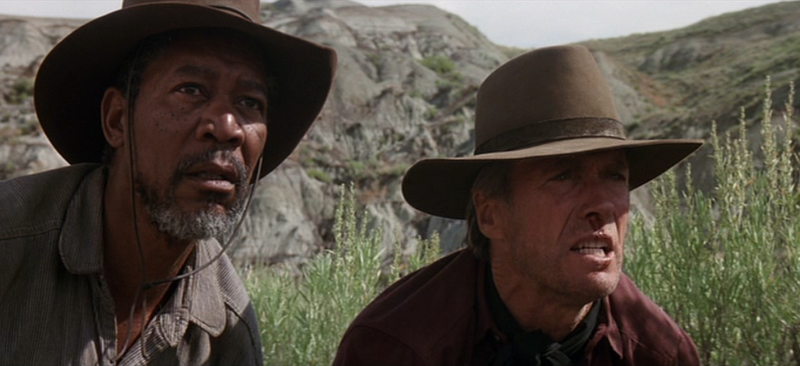
When audiences first encounter Munny, he does not look like the legendary killer others might expect. He is older, weathered, and living a quiet life far removed from the violent reputation of his past. He struggles with ordinary responsibilities and appears almost incapable of matching the terrifying stories told about him.
And yet, underneath that tired exterior is a history that cannot simply disappear.
The line, “You don’t look like no cold-blooded assassin,” captures one of the central ideas of the film. People often imagine killers as obvious monsters. They expect something visible in their appearance, something that immediately reveals the danger beneath the surface.
William Munny challenges that expectation.

He does not look like a legendary gunslinger.
He does not carry himself like a fearless outlaw.
He looks like a man who has lived through too much and wants to leave his violent past behind.
But Unforgiven is not a story about whether Munny can escape his past. It is a story about what happens when that past catches up with him.
The film takes place in a world where violence has become part of everyday life. Reputation matters. Stories spread quickly. Men build legends around themselves, and other people believe those legends without necessarily understanding the truth behind them.
Munny’s reputation is one of those legends.
But the reality is much more complicated.
The younger William Munny was capable of terrible violence. He was not simply a misunderstood hero who happened to live outside the law. The film makes it clear that his past contains cruelty, killing, and actions he deeply regrets.
Age and experience have changed him.
The man we see in 1992 is not the same person he once was.
That transformation gives the story its emotional weight.
Munny has tried to become someone else. He has built a life away from the violence that once defined him. But when circumstances force him back into the world of guns and revenge, the audience begins to see how fragile that transformation may be.
His journey is therefore not a traditional Western adventure.
It is a confrontation with memory.
With guilt.
With violence.
And with the consequences of becoming the person you once were.
Clint Eastwood’s performance is central to this effect. Rather than portraying Munny as an effortlessly confident gunslinger, Eastwood gives him a tired and restrained presence. There is very little glamour in the character.

That choice is important.
The film deliberately strips away many of the romantic ideas associated with classic Western heroes. Gunfights are not clean or elegant. Killing is not presented as a moment of uncomplicated triumph. Violence has consequences, and those consequences remain long after the shooting stops.
This makes the famous question about Munny’s appearance even more powerful.
He does not look like a cold-blooded assassin.
But perhaps that is exactly the point.
Violence does not always have a recognizable face.
The film repeatedly challenges the idea that good people and bad people can always be separated by appearance. Characters tell stories about themselves. Others create legends around them. But the truth is often much more uncomfortable.
Munny’s past is one example.
English Bob is another.
Little Bill Daggett provides yet another complicated perspective on violence and authority.
Each character contributes to the film’s larger examination of the myths surrounding the Old West.
In traditional Western stories, the gunslinger can often appear almost larger than life. He enters a town, faces his enemies, and walks away as a legend.
Unforgiven questions that mythology.
What does it actually mean to be good with a gun?
What happens to the people who are killed?
What happens to the person who pulls the trigger?
And what remains after the legend has been created?
These questions give the film a darker atmosphere than many traditional Westerns.
The landscape is beautiful, but the world is harsh.
The characters can be charismatic, but their actions are often morally complicated.
The violence can be shocking precisely because it does not feel glamorous.
That realism gives Unforgiven much of its enduring power.
The film also explores the difference between reputation and reality. Characters hear stories about dangerous men and form expectations based on those stories. But when they encounter the real person, the truth may be very different.
Munny’s appearance creates a contradiction.
He looks ordinary.
His reputation is extraordinary.
That contrast becomes one of the film’s most important themes.
The older Munny is physically vulnerable in ways the legendary version of himself would never seem to be. He struggles. He makes mistakes. He is not always confident. He does not possess the effortless control associated with traditional Western heroes.
Yet when the circumstances become extreme, another side of him emerges.
That transformation is disturbing precisely because the audience has already seen the man he was trying to become.
He does not simply become a hero again.
He becomes something much darker.
And Unforgiven refuses to tell the audience that this transformation is something to celebrate.
That is what separates the film from a conventional revenge Western.
Revenge may drive the story forward, but the film keeps asking what revenge actually costs.
There is anger.
There is grief.
There is fear.
There is guilt.
And there is the realization that violence changes everyone involved.
The title itself carries enormous weight.
Unforgiven is not simply about one person refusing to forgive another. It suggests a larger world in which forgiveness, guilt, punishment, and redemption are constantly in conflict.
Can a violent man truly change?
Can the past ever be buried?
Can someone who has committed terrible acts become a different person?
And if he does, what happens when circumstances force him to return to violence?
The film never offers simple answers.
That ambiguity is one reason Unforgiven remains such an important Western.
It respects the genre while questioning many of its traditional assumptions.
The cowboy is no longer automatically heroic.
The gunfighter is not automatically admirable.
The town marshal is not necessarily morally pure.
And the quiet, aging man sitting on the sidelines may carry a history far more frightening than anyone expects.
That is why the line, “You don’t look like no cold-blooded assassin,” resonates so strongly.
It captures the shock of discovering that appearances can be completely misleading.
William Munny does not look like the man described in the stories.
But legends rarely tell the whole truth.
And sometimes the most dangerous person in the room is the one who looks like he belongs nowhere near a gun.

🤠🔫 Unforgiven ultimately became much more than another Western. It became a meditation on violence, reputation, regret, and the myths people create around dangerous men.
Its characters are not simple heroes and villains.
They are damaged, complicated, ambitious, frightened, proud, and sometimes cruel.
That complexity is what gives the film its lasting power.
Decades after its release, Unforgiven still stands as one of the most memorable examinations of the Western myth ever put on screen.
And William Munny remains at the center of it all — a man who does not look like a cold-blooded assassin, but whose past reminds us that appearances can never tell the whole story.
Sometimes the quietest face carries the darkest history.
