🤠🔥 UNFORGIVEN (1992) — WHEN WILLIAM MUNNY COULDN’T ESCAPE HIS PAST
William Munny wanted to believe that his violent days were behind him.
Once feared as a ruthless gunfighter, Munny had spent years trying to become someone else. He had left behind the life of violence, settled down, and attempted to build a quieter existence far removed from the man he once was. But in the world of Unforgiven, the past is never as easy to bury as it seems.
Directed by Clint Eastwood, Unforgiven takes the traditional Western legend and turns it inside out. Instead of presenting the gunslinger as a glamorous hero, the film asks what violence really leaves behind. Its characters are older, damaged, complicated, and haunted by things they cannot simply forget.
At the center of the story is William Munny, a man whose appearance gives little indication of the reputation he once carried. He is not introduced as an unstoppable cowboy riding into town with confidence and a loaded revolver. He is a weathered farmer, struggling with his responsibilities and trying to raise his children after the death of his wife.
That contrast makes Munny so fascinating.
The man standing before the audience is not necessarily the man described by others. Stories about his past suggest a person capable of terrible violence, yet the Munny we initially see seems reluctant to return to that life. He understands that killing is not something that simply disappears because a person decides to change.
His decision to take one final job becomes the turning point.
What begins as a practical attempt to earn money gradually pulls Munny back toward the identity he had tried to leave behind. Along the way, the film refuses to make his transformation feel heroic. Every step toward violence carries a sense of consequence.
That is what separates Unforgiven from many traditional Westerns.
In countless classic Western stories, the gunslinger walks into town, defeats the villains, restores order, and rides away. Violence becomes part of the legend. The audience is encouraged to admire the skill, courage, and confidence of the hero.
Unforgiven asks a much darker question: what if the legend is wrong?
What if killing does not make someone noble?
What if a reputation for violence is not something to celebrate, but something to fear?
Munny’s journey is powerful because he does not fit comfortably into the role of hero or villain. He carries both sides within him. There is regret in his character, but there is also a capacity for violence that never completely disappears.
The film also surrounds him with other characters who challenge the mythology of the Old West.
English Bob represents the kind of larger-than-life gunfighter who has become famous through stories. His reputation travels ahead of him, creating an image that is almost larger than the man himself. But Unforgiven repeatedly questions whether such legends deserve to be believed.
Little Bill Daggett offers another version of power. As a sheriff, he presents himself as the person responsible for maintaining order. Yet his methods reveal how complicated that authority can become. The line between justice, control, punishment, and personal pride becomes increasingly difficult to define.
This is why the film’s title carries so much weight.
Unforgiven is not simply about people who have committed terrible acts. It is about people who cannot completely escape the consequences of those acts.

Munny wants to become a different man. But becoming different does not erase history.
His relationship with his late wife is particularly important to understanding him. She represents the life he wanted to build and the person he hoped to become. Her influence remains part of his identity even after she is gone. The memory of that life creates a powerful contrast with the violence that gradually returns.
As the story progresses, Munny becomes increasingly difficult to separate from his old reputation.
The most unsettling aspect of his character is that the audience may begin to understand why people are afraid of him. The quiet farmer is still capable of becoming something much darker.
And when that transformation finally happens, Unforgiven does not treat it as a triumphant return of a legendary cowboy.
It feels tragic.
The film suggests that violence can create legends, but legends can hide the human cost behind them. Behind every famous gunfighter story are people who were frightened, wounded, grieving, or killed.
That perspective gives the movie its lasting power.
Clint Eastwood’s performance is deliberately restrained for much of the film. He does not need constant speeches or dramatic gestures to communicate Munny’s history. His silence, hesitation, and expressions often say more than words could.
When Munny finally confronts the violent world he had tried to escape, the difference between his old identity and his new one becomes increasingly difficult to see.
And that is the tragedy.
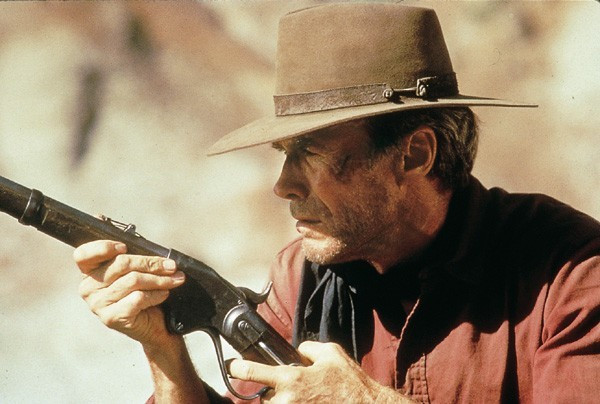
Perhaps Munny never completely escaped his past.
Perhaps the real battle was never about whether he could pull a trigger. It was about whether he could live with the person he had once been.
Unforgiven remains one of the most influential Western films because it refuses to give audiences an easy version of the cowboy myth. It presents the Old West as a place where violence has consequences and where reputation can become both a weapon and a prison.
William Munny is not simply a legendary gunfighter.
He is a man trying to outrun the memory of what he once was.
And when the past finally catches up with him, the result is not a celebration of the old Western hero.
It is a haunting reminder that some things can never truly be undone.
