The Legacy of Violence in Clint Eastwood’s Unforgiven (1992)
Few actors are as closely associated with the American Western as Clint Eastwood. For decades, his name became almost inseparable from the image of the quiet gunslinger, the lone cowboy, and the mysterious man who could walk into a dangerous town without saying much and still command attention. But in Unforgiven (1992), Eastwood returned to that familiar world for a very different reason. Instead of simply celebrating the mythology of the Western hero, he questioned it.
Directed by Eastwood and starring him as William Munny, Unforgiven became one of the most significant Western films of its era. Beneath its dusty landscapes, horses, guns, and frontier towns was a much darker examination of violence, regret, reputation, and the consequences of choices that cannot be undone.
William Munny is not the kind of cowboy audiences might expect to see at the beginning of a classic Western. He is older, tired, and living a quiet life as a farmer. His days of violence are supposed to be behind him. He has children to care for, memories of his late wife, and a desire to remain distant from the man he once was.
But the past has a way of returning.
Munny is drawn back into a dangerous situation that forces him to reconsider the life he thought he had left behind. What begins as a difficult decision gradually becomes a journey into a world of violence that he knows all too well.
That conflict is at the heart of Eastwood’s performance.
For much of his career, Eastwood had played characters who represented confidence, independence, and controlled violence. His Western persona was built on understatement. He did not need long speeches or exaggerated reactions. A look could communicate danger. A pause could create tension. His characters often seemed to exist outside the rules of ordinary society.
Unforgiven takes that persona and gives it history.
William Munny is not simply a mysterious stranger with a gun. He is a man who remembers what he has done. His violent past is not presented as an exciting collection of heroic adventures. Instead, it hangs over him like a burden.

This is one of the reasons the film feels so different from traditional Westerns.
Classic Western mythology often presents violence as a means of restoring justice. A dangerous outlaw threatens innocent people, a heroic gunfighter confronts him, and order is restored. The violence may be dramatic, but it is usually presented as necessary.
Unforgiven complicates that idea.
The film repeatedly asks what happens when violence is no longer romantic. What happens when the person holding the gun has regrets? What happens when revenge and justice become difficult to distinguish?
Eastwood does not provide simple answers.
Instead, he allows the characters and their actions to reveal the darker side of the frontier myth.
Munny’s past is particularly important because other characters have heard stories about him. Reputation becomes a powerful force throughout the film. A person’s name can create fear before that person even arrives. The legend can become larger than the individual.
But Unforgiven is skeptical of legends.
The film shows how stories about gunfighters can hide the suffering behind them. A famous outlaw may become a colorful character in a story, while the people affected by his violence disappear from the mythology.
That perspective gives the film an unusual emotional weight.
Eastwood also surrounds Munny with characters who represent different ideas about violence and authority. Morgan Freeman’s Ned Logan provides Munny with a connection to his past and a more reflective presence within the story. Gene Hackman’s Little Bill Daggett represents another kind of power: the authority of a man who believes he can control violence by controlling the town around him.
These characters create a complicated moral landscape.
There is no simple division between good people and bad people. Each character has motivations, weaknesses, beliefs, and contradictions.
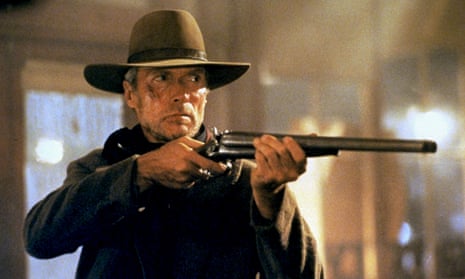
Little Bill may represent law and order, but his methods raise questions about what authority looks like when it becomes personal. Munny may be trying to live peacefully, yet the violent man from his past has never completely disappeared. Even the stories surrounding the other gunfighters reveal how easily truth can become distorted by reputation.
This complexity is what makes Unforgiven so memorable.
Eastwood’s direction is restrained and deliberate. The landscapes are beautiful, but the world itself feels unforgiving. The towns are not romantic playgrounds for cowboys. They are harsh places where people struggle with poverty, fear, power, and survival.
The film also avoids turning violence into spectacle simply for entertainment. When violence occurs, it carries emotional consequences.
That approach reflects a major evolution in Eastwood’s career.
By 1992, he was no longer simply the young Western star who had become famous through films such as A Fistful of Dollars, For a Few Dollars More, and The Good, the Bad and the Ugly. He had become an established filmmaker capable of looking back at the genre that helped define him.
In that sense, Unforgiven feels almost like a conversation between Eastwood’s past and present.
The younger Eastwood had become an icon by playing characters who operated according to their own code. The older Eastwood returned to the same landscape and asked what that code actually meant.
What happens to the gunslinger when he gets older?
What happens when the legend becomes a memory?
What happens when the person who once seemed fearless begins to understand the true cost of violence?
Unforgiven does not treat age as a weakness. Instead, age gives Munny’s character a deeper sense of history. He has lived long enough to understand that violence does not end when the gunshot ends.
The emotional impact of the film comes from this realization.
Munny wants to believe that he has changed. His new life represents an attempt to leave the past behind. Yet the circumstances surrounding him make that increasingly difficult.
And when he finally embraces the violent side of himself again, the moment does not feel like the triumphant return of a legendary hero.
It feels tragic.
That distinction is crucial.
Eastwood’s performance makes Munny simultaneously intimidating and deeply human. He is capable of frightening violence, but the film never allows the audience to forget that there is a person beneath the legend.
That is why the title Unforgiven carries such power. Forgiveness is not simple in this world. Some characters seek justice. Others seek revenge. Some want redemption. Others want control. But everyone is forced to confront the consequences of their choices.
The film’s legacy is enormous because it helped redefine what a Western could be.
Rather than presenting the Old West as a place of simple heroes and villains, Unforgiven presents it as a world of moral uncertainty. Its characters are shaped by their pasts, and their decisions have consequences that cannot simply be erased.
For Clint Eastwood, the film also became an important statement about his own relationship with the Western genre.

He had spent decades embodying the image of the gunslinger. With Unforgiven, he looked directly at that image and stripped away much of its glamour.
The result was a Western that feels both familiar and completely different.
There are still horses, guns, frontier towns, and unforgettable confrontations. But beneath those familiar elements is a much deeper question about violence and memory.
William Munny is not remembered simply because he was dangerous.
He is remembered because he tried to become a different man—and because the world he left behind refused to disappear completely.
That is the lasting power of Unforgiven.
It is a film about the Old West, but it is also a film about aging, regret, reputation, and the difficult possibility of redemption. And through Clint Eastwood’s unforgettable performance, it became one of the most powerful examples of how a Western could look back at its own mythology and ask whether the legends we admire tell the whole story.
🤠🌵 More than three decades later, Unforgiven remains a defining chapter in Clint Eastwood’s career—and one of the Western films that most profoundly challenged the legend of the American cowboy.
