Danny Tommo Remanded in Custody After Denying Channel Boat Charges as Bail Decision Fuels Political Row
Daniel Thomas, better known as anti-migration activist Danny Tommo, has been remanded in custody after pleading not guilty to two charges arising from an incident in the English Channel. His supporters have portrayed the refusal of bail as evidence of unequal treatment, while the available court reporting presents a narrower legal question: whether Thomas should remain detained while criminal proceedings continue. With a Crown Court hearing scheduled for 29 September, the case has become entangled with a much broader argument over immigration, protest, policing and public confidence in the justice system.
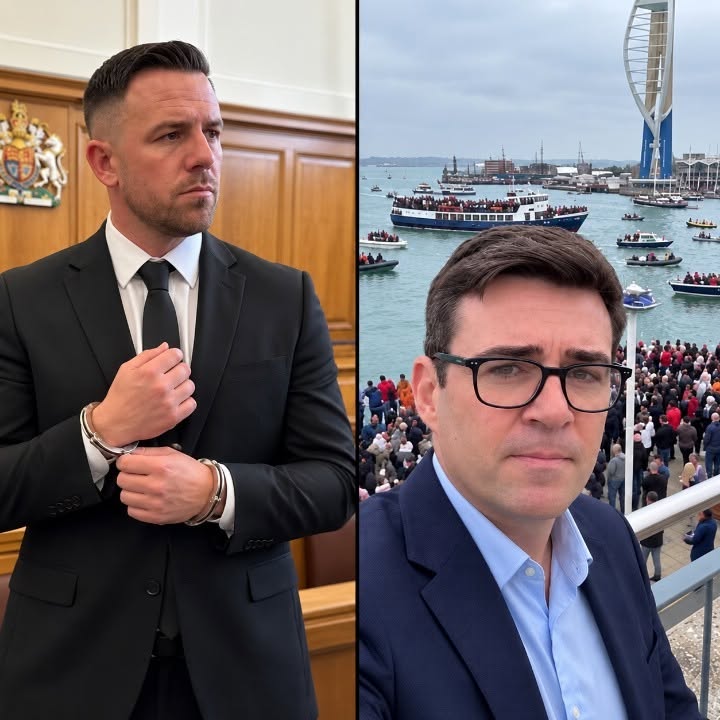
The increasingly heated debate surrounding Danny Tommo has moved from demonstrations, livestreams and the waters of the English Channel into the criminal courts.
Daniel Thomas, 37, known publicly as Danny Tommo, appeared by video link at Basingstoke Magistrates’ Court on Friday, 25 September. He pleaded not guilty to one count of criminal damage and to a separate allegation that he failed to disclose the PIN for his mobile phone under Section 53 of the Regulation of Investigatory Powers Act 2000. The court refused bail and remanded him in custody pending his next appearance at Portsmouth Crown Court on Tuesday, 29 September. Hampshire Police
Those basic facts are important because much of the discussion surrounding the case has already gone substantially further than what has actually been established in court.
Thomas has not been convicted of either charge. His pleas are not guilty, and the prosecution allegations remain allegations unless and until they are proved to the required criminal standard.
Equally, being remanded in custody is not itself a finding of guilt. Bail proceedings determine whether somebody should remain in custody while a case proceeds; they do not determine whether the prosecution has proved its substantive case.
That distinction has become particularly important as supporters of Thomas describe his detention as an example of “two-tier justice”, while critics argue that the decision represents the ordinary operation of criminal law following an unusual and highly publicised incident.
At this stage, the publicly available evidence does not establish either broad political interpretation as a judicial finding.
What it does establish is a rapidly developing criminal case that has become inseparable from Britain’s increasingly confrontational debate over Channel crossings.
What Daniel Thomas Has Actually Been Charged With
Hampshire and Isle of Wight Constabulary announced on the evening of 24 September that Thomas had been charged in connection with an incident in the English Channel two days earlier.
Police identified him as Daniel Thomas, aged 37 and of no fixed abode, and confirmed two charges.
The first is one count of criminal damage.
The second concerns an alleged failure to comply with a notice requiring him to disclose his phone PIN under Section 53 of the Regulation of Investigatory Powers Act 2000.
Police said the charges followed an allegation that a boat had been damaged in the Channel while an emergency responder was aboard. Hampshire Police
Reporting from Thomas’s subsequent court appearance provides more detail about the prosecution’s version of events.

Prosecutor Kevin Lucie told the court that Thomas allegedly approached an adrift boat and damaged it using a knife. The court was told that a crew member was aboard and that the vessel could be heard losing air. Searchlight Magazine
Thomas denies criminal wrongdoing.
That point must remain central to any responsible account of the case.
Videos circulating online may become evidence, but edited clips, livestreams and social-media commentary are not substitutes for the evidential process that will occur in court. Questions about precisely what happened, Thomas’s intentions, the condition and ownership of the vessel, the circumstances surrounding the emergency responder, and how the relevant criminal law applies will ultimately depend on evidence and legal argument.
The Crown Prosecution Service has also emphasised the defendant’s right to a fair trial.
In a statement reported after Thomas was charged, the CPS said prosecutors had concluded that there was sufficient evidence for proceedings and that prosecution was in the public interest. It simultaneously reminded the public that the proceedings are active and that Thomas is entitled to a fair trial. RTE
That warning matters in a case generating enormous attention online.
Charging somebody does not mean prosecutors have proved the charge. It means the threshold for bringing the prosecution has been met.
The defence will have an opportunity to challenge the prosecution case.
Thomas Pleads Not Guilty
At Basingstoke Magistrates’ Court, Thomas pleaded not guilty to both allegations.
He elected to have the case dealt with at Crown Court rather than proceeding to trial before magistrates. His next hearing was consequently scheduled for Portsmouth Crown Court on 29 September. AOL
Deputy Senior District Judge Tan Ikram was reported as saying there was a “real possibility of an immediate custodial sentence” when dealing with the question of bail. Searchlight Magazine
Thomas was then remanded in custody.
The decision immediately became the central political issue surrounding the case.
Stephen Yaxley-Lennon, widely known as Tommy Robinson, attended the hearing and publicly condemned the refusal of bail. He said Thomas’s legal representatives would continue fighting for his release when the proceedings reached the Crown Court. AOL
Supporters subsequently argued that stringent conditions could have been imposed instead of imprisonment.
Claims circulating online have described possible restrictions including electronic monitoring, limitations on social-media use and geographical restrictions.
However, those details should be treated carefully unless confirmed through reliable court reporting or official documentation. The clearly established fact is that bail was refused at the Magistrates’ Court and Thomas remained in custody pending the Portsmouth Crown Court hearing.

Why Can Someone Who Has Not Been Convicted Be Held in Prison?
This is perhaps the most important legal question generated by the case.
Under English law, defendants generally benefit from a presumption in favour of bail, but that right is not absolute.
The Bail Act 1976 provides the statutory framework.
Among the recognised circumstances in which bail can be refused are situations where a court finds substantial grounds for believing that a defendant might fail to surrender, commit an offence while on bail, interfere with witnesses or otherwise obstruct justice. Legislation UK
The government similarly explains that a defendant can be remanded where, for example, the court believes the person may fail to attend a future hearing or commit an offence while released. GOV.UK
The system also allows courts to impose conditions designed to address identifiable risks rather than automatically detaining defendants.
Conditions can include electronic monitoring and other restrictions.
Recent reforms are particularly relevant. The Sentencing Act 2026 amended parts of the bail framework with the stated objective of reducing unnecessary custodial remands, particularly where there is no realistic prospect of an immediate prison sentence.
Government guidance says courts should consider alternatives to custodial remand where appropriate while continuing to account for public safety and the administration of justice. GOV.UK
That makes the legal issue more nuanced than either “everyone is entitled to bail” or “being charged means you should be imprisoned.”
Neither proposition accurately describes the law.
A court considers the alleged offences, the circumstances of the defendant, potential risks, available conditions and the statutory framework.
Thomas’s lawyers can continue to challenge the detention through the appropriate legal process.
The Channel Incident at the Centre of the Case
The prosecution arose from extraordinary scenes in the English Channel on 22 September.
Thomas had been following activity involving small boats and rescue operations while broadcasting material online.
Earlier reporting said authorities were examining livestream footage that appeared to show Thomas using a blade against an inflatable vessel after people who had been travelling aboard it had been removed. Guardian
The circumstances surrounding the boat are now central to the criminal proceedings.
Reporting from the court says prosecutors allege that Thomas directed his vessel toward an adrift boat, armed himself with a knife and damaged it while a rescue worker was aboard. AOL.com
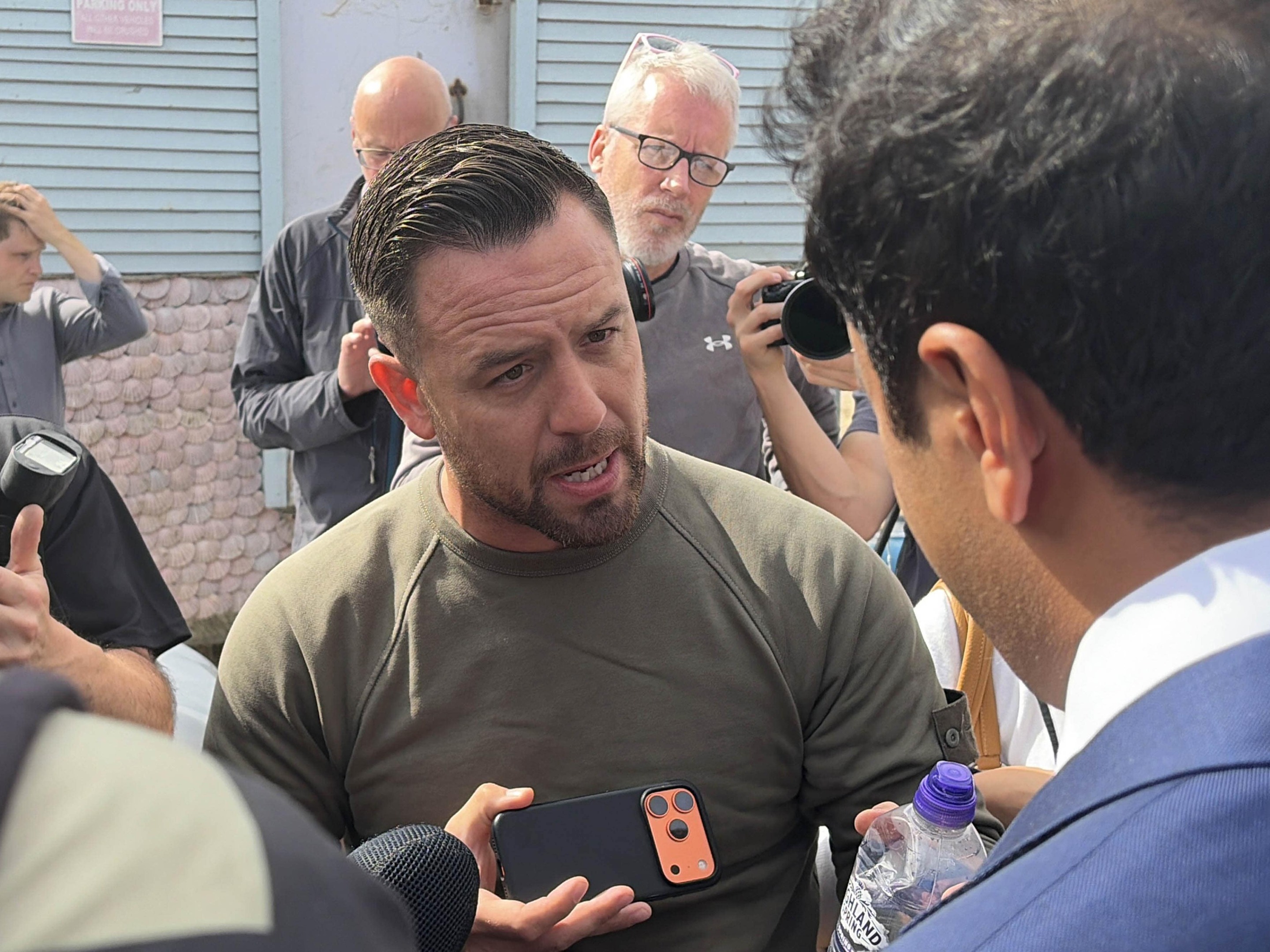
Again, these are prosecution allegations rather than findings of fact.
The defence has yet to present its full case publicly, and Thomas’s not-guilty pleas make clear that the prosecution account is contested.
The incident nevertheless represents an important development in Britain’s anti-migration protest movement.
Previous demonstrations have largely taken place on streets, outside hotels, near ports or around government facilities.
The Channel incident moved activism directly into the maritime environment where Border Force, lifeboats and other vessels may be conducting operations.
That raises questions considerably different from those surrounding a conventional protest.
Freedom to demonstrate against immigration policy does not provide immunity from generally applicable criminal law. Conversely, political motivation does not eliminate the ordinary procedural rights afforded to a defendant.
Both principles can exist simultaneously.
From Channel Activism to a Criminal Courtroom
Thomas has become an increasingly visible figure within anti-migration activism in southern England.
He has been associated with demonstrations challenging government policy on asylum accommodation and Channel crossings, including protests around Dover and Portsmouth.
The Irish Times reported earlier in September that Thomas had played a prominent role in organising anti-immigration demonstrations along England’s south coast. The Irish Times
Those demonstrations have taken place against a broader background of intense political concern over irregular Channel crossings.
For Thomas and his supporters, the issue is framed principally around sovereignty, border control and the argument that governments have failed to prevent unauthorised arrivals.
Opponents of the movement frequently focus instead on intimidation, hostility toward migrants and the risk that confrontational demonstrations can produce disorder.
Those competing interpretations have increasingly collided in public spaces.
Thomas’s prosecution has therefore become something larger than an individual criminal case in the eyes of many people following it.
Supporters see his detention through the lens of their existing distrust of immigration policy and public institutions.
Critics see the case as a test of whether confrontational political activism remains subject to ordinary law.
But courts do not formally determine those wider ideological disputes when deciding bail.
They determine the individual case before them.
The “Two-Tier Justice” Claim
Perhaps the strongest reaction following Thomas’s detention has centred on allegations of “two-tier justice.”
The argument presented by some supporters is essentially comparative.
They contend that British citizens protesting against immigration can face rapid arrest, prosecution and imprisonment on remand while people arriving unlawfully by small boat are accommodated rather than immediately detained or imprisoned.
That comparison has considerable political force among sections of the electorate.
Legally, however, it combines two substantially different processes.
A defendant appearing in a criminal court after being charged with a specific criminal offence is being dealt with under criminal procedure.

A person arriving across the Channel may enter immigration and asylum processes governed by a different body of legislation, administrative rules and international obligations. Their accommodation while an immigration or asylum case is considered is therefore not equivalent to criminal bail.
Whether government immigration policy is too permissive, too restrictive or poorly administered is a legitimate political question.
It is separate from the narrower legal question of whether a particular defendant satisfies the statutory requirements for bail.
Consequently, Thomas’s remand decision alone does not prove the existence of politically discriminatory justice.
Nor does that mean public concerns about consistency in policing and prosecution should simply be dismissed.
Claims of unequal treatment can be investigated empirically by examining comparable defendants, comparable alleged offences, charging decisions, bail outcomes and sentencing patterns.
The crucial word is comparable.
Comparing defendants facing similar allegations is considerably more informative about criminal-justice consistency than comparing criminal defendants with people undergoing immigration procedures.
Why the Speed of the Case Has Attracted Attention
Another complaint from Thomas’s supporters concerns the speed with which events developed.
The Channel incident occurred on 22 September.
Police arrested Thomas shortly afterwards.
Charges were announced on 24 September.
He appeared before magistrates on 25 September.
His Crown Court appearance was then scheduled for 29 September.
That is undeniably a rapid sequence.
But speed alone is not evidence that authorities are attempting to secure a predetermined outcome.
Criminal proceedings can move quickly in their early stages, particularly where a suspect has been detained and must be brought before a court within legally prescribed timeframes.
Indeed, the purpose of prompt judicial scrutiny is partly to prevent police detention from continuing indefinitely without court supervision.
Once a defendant is charged and held, questions surrounding liberty necessarily become urgent.
The more important questions are therefore whether the proper procedures were followed, whether the defendant had legal representation, whether the court considered the bail application according to law and whether subsequent proceedings provide the defence with adequate opportunity to challenge the prosecution case.
Those questions can be assessed as more information becomes available.
Why Remand Is Not a Sentence
The language used online has sometimes described Thomas as having already been “sent down” or jailed for his activism.
That description risks confusing remand with punishment following conviction.
Thomas is currently an unconvicted defendant.
A person held on remand is deprived of liberty, and that is obviously a serious consequence. But legally it is different from serving a sentence after conviction.
The presumption of innocence remains.
If Thomas is ultimately acquitted, the fact that he spent time on remand does not retrospectively become a criminal sentence.
Likewise, if he is eventually convicted, sentencing would occur through a separate judicial process.
This distinction is one reason bail decisions receive significant legal scrutiny.
Holding somebody who has not been convicted is a substantial exercise of state power.
Courts therefore have to balance the defendant’s liberty against identified risks and the proper administration of justice.
What Does the Phone-PIN Charge Mean?
The second charge has received less attention than the alleged criminal damage but could become an important element of proceedings.
Thomas is accused of failing to comply with a legal requirement to disclose access information for his mobile phone under Section 53 of the Regulation of Investigatory Powers Act.
The law provides mechanisms through which authorities can, in specified circumstances, require disclosure of protected information or the means necessary to access it.
Thomas denies this allegation as well.
The existence of the charge does not tell the public what evidence investigators may believe is stored on the device, nor should speculation fill that gap.
It establishes only that prosecutors allege he failed to comply with a lawful disclosure requirement.
Whether all statutory requirements were satisfied and whether Thomas has a defence are matters for the proceedings.
The Role of Social Media
Few modern criminal cases illustrate the collision between activism, social media and criminal justice as clearly as this one.
Thomas has developed his political profile partly through direct online communication.
Livestreaming allows activists to bypass traditional broadcasters and communicate immediately with large audiences.
That can radically alter how an incident develops.
An event can simultaneously be a political demonstration, a livestream watched by thousands, a police investigation and potential evidence in subsequent criminal proceedings.
But online audiences often make judgments much faster than courts.
Within hours, competing narratives become established.
Supporters select clips that appear to validate their interpretation.
Opponents circulate different moments.
Commentators assign motives.
Political figures become involved.
Algorithms reward the strongest emotional reactions.
Meanwhile, the judicial process moves according to entirely different standards.
Courts require admissible evidence, legal argument and procedural fairness.
A viral video can certainly be evidence, but its evidential significance depends upon context, authenticity and the legal issues actually before the court.
The difference between those two systems — instant online judgment and methodical legal adjudication — is becoming increasingly significant in politically charged prosecutions.
Supporters Gather Following Thomas’s Arrest
The arrest itself produced a rapid mobilisation.
Several hundred people gathered outside a police investigation centre in Basingstoke on the evening before Thomas’s court appearance, apparently believing he was being held there.
Police maintained a visible presence while the demonstration continued for several hours. AOL
Supporters also attended his court appearance.
The demonstrations underline Thomas’s ability to mobilise people quickly and illustrate why his prosecution is unlikely to remain an obscure criminal proceeding.
Every future hearing could become a focal point for wider arguments over immigration and policing.
That presents challenges for both supporters and authorities.
People remain entitled to peaceful protest.
At the same time, courts must be able to operate without intimidation or interference, and defendants must be tried according to evidence rather than pressure from either supporters or opponents.
The Wider Portsmouth and Dover Context
Thomas’s case cannot be separated entirely from recent demonstrations on Britain’s southern coast.
Dover has long occupied a symbolic position in the migration debate because of its proximity to continental Europe and its role in Channel arrivals.
Portsmouth and other coastal communities have increasingly become involved as migration routes and operational responses change.
Recent reporting has described longer Channel journeys originating farther west along the French coast, creating additional challenges for British and French authorities and rescue organisations. The Sun
For campaigners demanding stronger border enforcement, such developments reinforce the argument that government strategy has failed to deter crossings.
For rescue organisations and officials, the priority when people are at sea can involve preventing loss of life regardless of the immigration status of those aboard.
These objectives can produce intense political friction.
Border enforcement, maritime rescue and asylum processing are related but legally distinct responsibilities.
When activists attempt to intervene directly at sea, another layer of complexity is added.
Can Citizens Intervene Against Suspected Illegal Immigration?
This is one of the broader questions raised by the episode.
People can campaign for stronger immigration enforcement.
They can protest.
They can document events from lawful locations.
They can petition Parliament, lobby politicians, organise demonstrations and challenge government policy through political and legal channels.
But suspicion that another person has violated immigration law does not generally give a private individual unlimited authority to interfere with vessels, property, rescue operations or people.
Exactly where Thomas’s conduct falls within criminal law is what the courts will determine.
That determination should not be prejudged either by supporters describing his actions as inherently lawful border defence or opponents treating the disputed criminal allegations as already proven.
What About the Claim That Migrants Receive Hotels While Protesters Receive Prison?
This slogan has become one of the most emotionally powerful reactions to the case.
It captures a genuine political dispute but oversimplifies the legal comparison.
People seeking asylum may receive accommodation while their claims are processed.
That accommodation has generated major controversy over costs, local capacity, fairness and government competence.
Those questions can and should be debated.
But asylum accommodation is not a reward equivalent to bail, just as custodial remand is not punishment for holding an unpopular political opinion.
One system concerns immigration status.
The other concerns criminal proceedings.
A person accused of a criminal offence is entitled to exactly the same bail framework regardless of whether their politics are popular or unpopular.
If evidence emerges showing comparable defendants were systematically treated differently because of political beliefs, that would raise a serious rule-of-law concern.
But establishing that proposition requires evidence beyond the difference between the immigration system and criminal courts.
Political Speech Versus Criminal Conduct
The Thomas case also highlights an increasingly difficult boundary in British public life.
Strong criticism of immigration policy is lawful political expression.
Calling for tougher borders is lawful.
Arguing that asylum policy has failed is lawful.
Organising lawful demonstrations around those beliefs is also protected political activity.
But political motivation does not automatically transform otherwise criminal conduct into protected speech.
The reverse is equally important.
Authorities should not treat lawful political speech as criminal simply because officials or other citizens consider it offensive or objectionable.
The task for courts is to separate those categories.
Thomas has not been charged merely with expressing opposition to immigration.
The publicly announced charges concern alleged criminal damage and an alleged failure to disclose his phone PIN following a legal requirement. Hampshire Police
Whether the prosecution can prove those offences is a different question.
Public Confidence Is Becoming Part of the Story
Whatever the eventual outcome, authorities face a broader challenge.
Large numbers of people increasingly interpret individual criminal cases through political identities.
An arrest involving an immigration campaigner is immediately understood by supporters as evidence about immigration policy.
An arrest involving protesters from another political movement can generate the same reaction among their supporters.
That environment makes confidence in transparent and consistent procedures particularly important.
Justice must not only avoid political discrimination; institutions need sufficiently clear procedures that claims of discrimination can be tested against evidence.
Court reporting therefore matters.
So do published judgments and reasons where available.
The strongest response to accusations of politically selective justice is not rhetorical reassurance. It is demonstrable consistency across comparable cases.
What Happens on 29 September?
The next important development is expected at Portsmouth Crown Court on Tuesday, 29 September.
Because Thomas elected Crown Court trial, proceedings will move into that jurisdiction. AOL
His legal team may continue efforts concerning bail, as his supporters have indicated.
The Crown Court process will also begin establishing how the substantive criminal case moves forward.
Until then, Thomas remains an unconvicted defendant who has entered not-guilty pleas.
The Crown Court hearing should provide greater clarity about the timetable, the status of bail and potentially the future conduct of the case.
What it will not necessarily provide is an immediate resolution of the political dispute surrounding him.
A Case Now Carrying Far More Than Two Criminal Charges
At its narrowest level, the case is straightforward to describe.
Daniel Thomas has been charged with criminal damage and with an offence relating to the alleged non-disclosure of his phone PIN.
He denies both allegations.
A magistrates’ court refused him bail.
He was remanded in custody.
His next hearing is scheduled for Portsmouth Crown Court on 29 September. Hampshire Police
Everything surrounding those facts is considerably more complicated.
To his supporters, Thomas has become a symbol of frustration with immigration enforcement and what they regard as inconsistent treatment by British institutions.
To his critics, the Channel incident illustrates the risks of increasingly confrontational anti-migration activism.
Neither political interpretation determines the criminal case.
The prosecution must establish its allegations through evidence.
The defence has the right to challenge that evidence.
The court must determine questions of bail and ultimately guilt according to law rather than political popularity.
And the public is entitled to scrutinise how those decisions are made.
For now, therefore, claims that Thomas has already been proved to have committed a crime go beyond the established facts.
So too do claims that his detention has already proved a politically motivated “stitch-up” or a system of “two-tier justice.”
The most significant evidence will come not from viral posts or political slogans but from what is placed before the courts.
That process is only beginning.
When Thomas appears at Portsmouth Crown Court on 29 September, attention will again focus on whether he remains in custody and how the prosecution proceeds.
Beyond the courtroom, however, the controversy is unlikely to disappear.
Britain’s argument over Channel migration has already moved from Parliament to hotels, streets, ports and beaches.
The Danny Tommo case has now carried that argument into the criminal courts — where the central question must remain considerably narrower:
what can actually be proved, and what does the law require once those facts have been established? Hampshire Police
