The dust arrives before the violence.
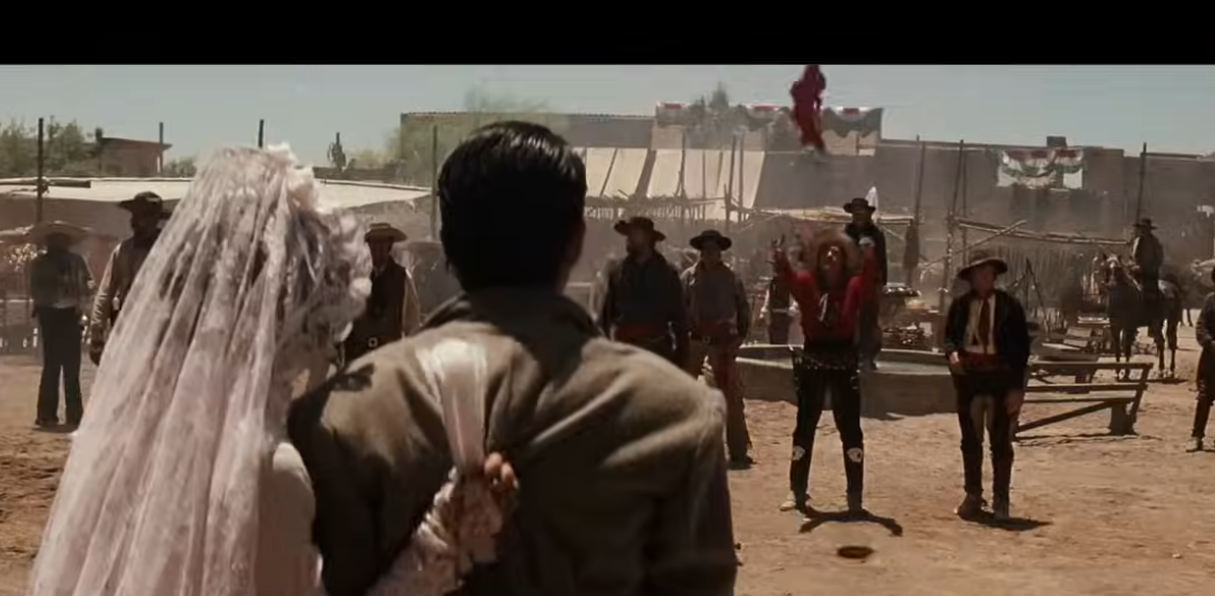
A group of riders appears on the horizon, their horses cutting through the desert while a peaceful Mexican wedding unfolds nearby. Music, celebration, family, and tradition fill the village. For a few moments, the scene feels almost untouched by the lawlessness spreading across the Arizona Territory.
Then the Cowboys arrive.
The mood changes instantly.

What follows in this sequence from Tombstone (1993) is more than another Western shootout. It is one of the clearest demonstrations of what the Cowboys represent in the film—and one of the most memorable showcases for Michael Biehn’s Johnny Ringo.
Ringo does not need to shout to become frightening. He does not need to prove himself with a dramatic gunfight. His danger comes from something colder: intelligence, calmness, and the unsettling feeling that violence means almost nothing to him.
That quality separates him from many of the men around him.
Curly Bill Brocius is loud, impulsive, and openly wild. He laughs, drinks, fires his gun, and enjoys chaos as though it were entertainment. Ringo is different. He watches. He thinks. He carries an intensity that seems deeper than ordinary outlaw bravado.
This wedding sequence puts that difference on full display.
The setting is essential.
A wedding represents beginnings.
Two people are building a future.
Families have gathered.
The community is celebrating continuity, love, and hope.
Then men whose lives revolve around intimidation and destruction ride directly into that world.
The contrast could not be stronger.
Tombstone repeatedly places civilization and lawlessness beside each other. The town itself is growing rapidly, filled with businesses, gambling halls, saloons, families, lawmen, miners, and men searching for fortune. But just beyond that attempt at order exists another system entirely.
The Cowboys operate according to strength.
They ride together.
They wear red sashes.
They intimidate anyone who cannot fight back.
Their power depends on fear.
The Mexican wedding sequence shows what that power looks like when nobody is present to stop them.

They are not facing Wyatt Earp.
They are not dealing with Doc Holliday.
They are not confronting armed lawmen who can shoot back.
They are entering a community that simply wants to celebrate.
That makes their behavior more revealing.
Anyone can appear dangerous in a fair gunfight.
Cruelty toward people who pose no real threat tells us something different.
The Cowboys turn celebration into terror almost casually.
Their horses tear through the village.
Gunfire replaces music.
People run for cover.
The visual transformation happens incredibly quickly.
A space that felt alive suddenly becomes chaotic.
This is not presented as a heroic Western battle.
It feels ugly.
And that ugliness matters because Tombstone needs the audience to understand what Wyatt Earp and his allies will eventually be fighting against.
The Cowboys are not merely colorful opponents.
They create fear wherever they go.
Johnny Ringo becomes especially memorable in the aftermath.
Michael Biehn plays him with remarkable restraint.
Look at his face.
There is very little uncontrolled emotion.
Other men might laugh loudly or celebrate what has happened.
Ringo seems almost detached.
That emotional distance makes him more disturbing.
He appears capable of violence without needing the excitement that usually accompanies it.
It is simply part of his world.
That calmness also creates the perfect foundation for one of the darkest lines associated with the sequence.
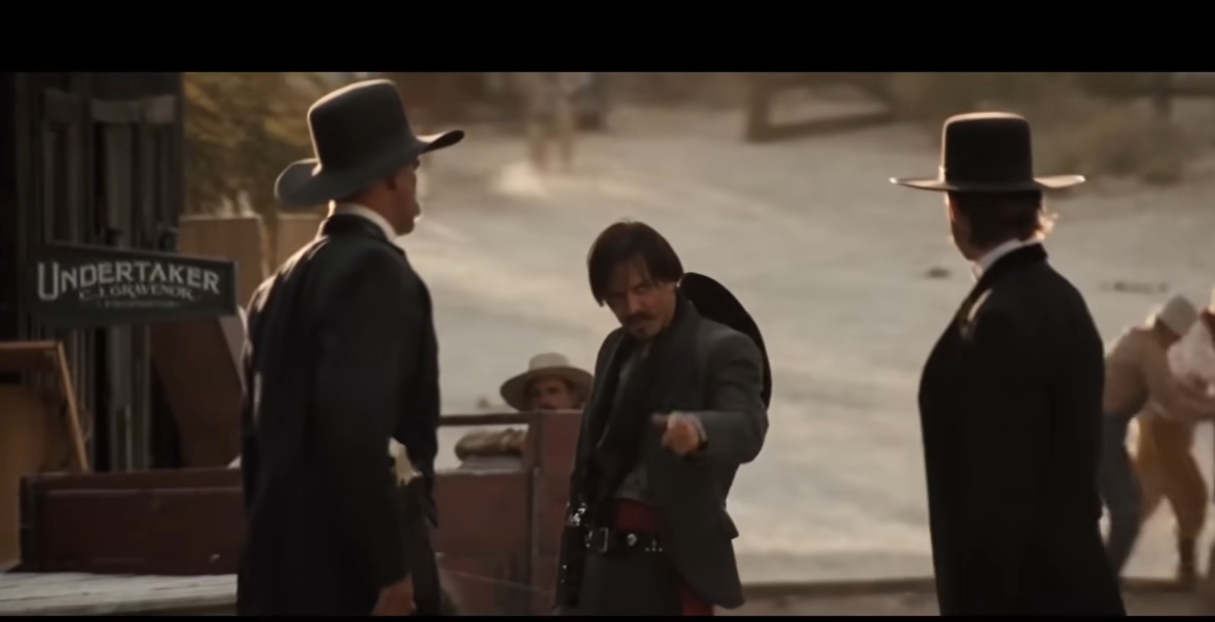
The Biblical imagery surrounding death and hell fits Ringo perfectly.
The phrase about the pale horse—death riding forward with hell following behind—comes from the Book of Revelation. Within the context of Tombstone, that image becomes far more than a religious reference.
It becomes a description.
Men have ridden into a peaceful place.
Death has followed them.
The celebration has been destroyed.
Ringo’s familiarity with such language adds another layer to his character.
He is not portrayed as an ignorant outlaw who knows nothing beyond guns and drinking.
He reads.
He recognizes references.
He understands ideas.
That makes him harder to dismiss.
Intelligence combined with violence is often far more frightening than violence alone.
Curly Bill can explode.
Johnny Ringo can think.
That distinction becomes increasingly important later in the film, particularly once Ringo is placed opposite Doc Holliday.
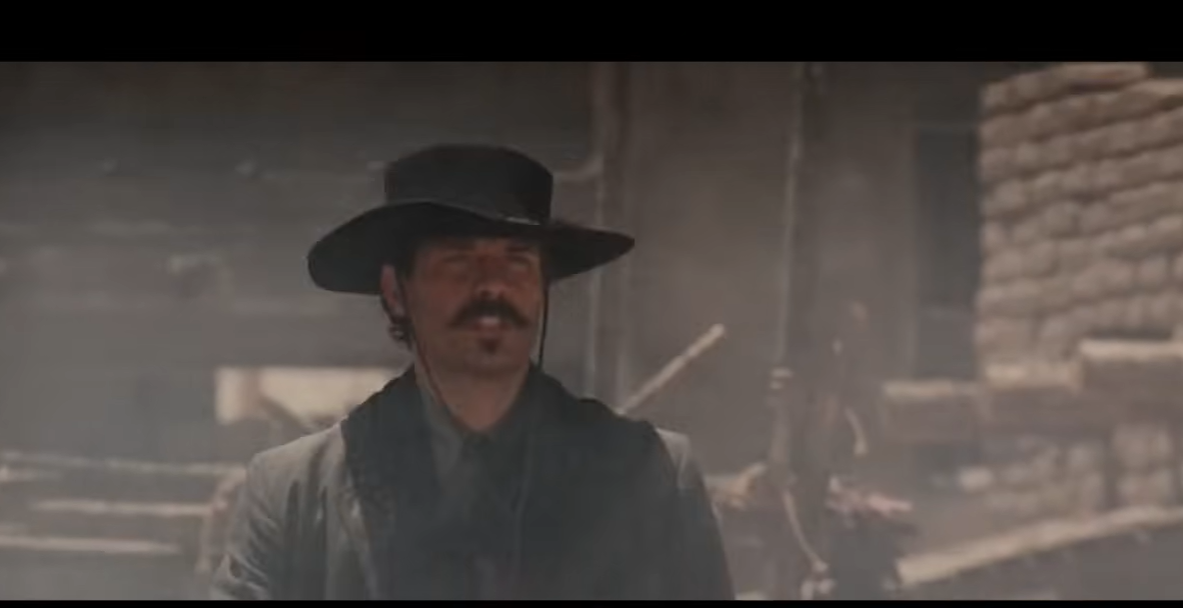
Doc recognizes something in him immediately.
Both men are educated by the standards of the people around them.
Both understand language.
Both possess exceptional skill with weapons.
Both live unusually close to death.
And both seem capable of seeing through the performances other men use to appear tough.
Their rivalry therefore feels deeper than a simple question of who can draw faster.
Ringo and Doc are mirrors.
But they reflect very different kinds of darkness.
Doc Holliday is dying.
He knows it.
His humor, recklessness, and loyalty exist under the shadow of that knowledge. He can be dangerous, but he also forms deep attachments. His friendship with Wyatt matters enormously to him.
Ringo feels more isolated.
His darkness does not seem softened by the same loyalty.
The wedding sequence gives us an early glimpse of that emptiness.
The surrounding Cowboys belong to a gang.
Ringo feels like something else.
He is among them, yet psychologically he often appears alone.
That is one reason Michael Biehn’s performance remains so effective.
He does not try to make Ringo constantly theatrical.
Instead, he creates tension by holding back.
The viewer senses that the character is always calculating something.
His eyes move before his body does.
His expression rarely gives away everything.
The result is a villain who feels dangerous even while standing still.
That is difficult to achieve.
Western cinema contains countless outlaws who announce their danger by screaming, fighting, shooting bottles, threatening strangers, or reaching dramatically for a revolver.
Ringo does not need those signals.
The audience understands him through stillness.
The wedding scene also demonstrates how Tombstone uses groups effectively.
The Cowboys are frightening partly because of numbers.
One man behaves badly.
Another laughs.
Someone fires a weapon.
Others encourage the behavior.
Individual responsibility begins disappearing inside the group.
The gang creates permission.
Actions that one man might hesitate to commit alone become easier when everyone around him is participating.
That dynamic makes the Cowboys more believable as a threat.
They do not control territory simply because one of them is a talented gunfighter.
They control it because they operate as a culture.
Violence is rewarded.
Cruelty becomes entertainment.
Fear becomes authority.
The red sash turns that culture into a visible identity.
By the time Wyatt Earp later declares war on anyone wearing one, the audience understands exactly what the symbol means.
That later campaign would feel very different without scenes like this one.
The wedding sequence gives emotional context to the conflict.
The Cowboys have already shown what happens when nobody challenges them.
That makes Wyatt’s eventual transformation from reluctant former lawman into relentless hunter easier to understand.
The film spends significant time showing him resist that role.
Wyatt comes to Tombstone hoping to make money.
He does not initially want another badge.
He does not want another crusade.
But men like Curly Bill and Johnny Ringo make neutrality increasingly impossible.
This is one of the central tensions in Tombstone.
Can a man truly leave violence behind if violence refuses to leave him alone?
Wyatt wants ordinary life.
Morgan and Virgil want stability.
The Cowboys keep pushing.
Eventually, the conflict becomes personal.
And once it becomes personal, the film changes completely.
The later Vendetta Ride is therefore not simply a series of exciting gunfights.
It is the answer to everything that came before.
Scenes such as the Mexican wedding show the disease.
Wyatt’s campaign becomes the response.
Yet the film remains compelling because it does not make violence feel completely clean.
Every act creates another consequence.
People die.
Families break.
Friendships are tested.
Even victory carries a price.
The wedding sequence establishes that cost visually.
Before the Cowboys arrive, people are celebrating life.
After they arrive, the same location is filled with fear and death.
That transformation is what lawlessness actually means.
Not colorful gunslingers posing in dusty streets.
Not dramatic one-liners.
Not romantic frontier mythology.
It means ordinary people lose the ability to live ordinary lives.
That is why this scene has such power despite not being the film’s most famous gunfight.
It reveals stakes.
It shows us what happens outside Tombstone’s saloons and gambling halls.
The Cowboys’ world does not only affect armed men who voluntarily enter confrontations.
It reaches weddings.
Families.
Communities.
People who never asked to become part of the conflict.
Johnny Ringo’s presence becomes symbolic of that darkness.
He is cultured enough to recognize the language of Revelation.
He is intelligent enough to understand the imagery of death.
And yet none of that knowledge prevents him from participating in destruction.
If anything, the contrast makes him more unsettling.
Knowledge has not civilized him.
Intelligence has not softened him.
He can recognize poetry while standing comfortably beside violence.
That contradiction makes him one of Tombstone’s most fascinating characters.
Michael Biehn plays the contradiction beautifully.
Ringo can appear almost elegant compared with the rougher Cowboys around him.
Then a look crosses his face and the viewer remembers exactly what kind of man he is.
That danger eventually makes his confrontation with Doc Holliday inevitable.
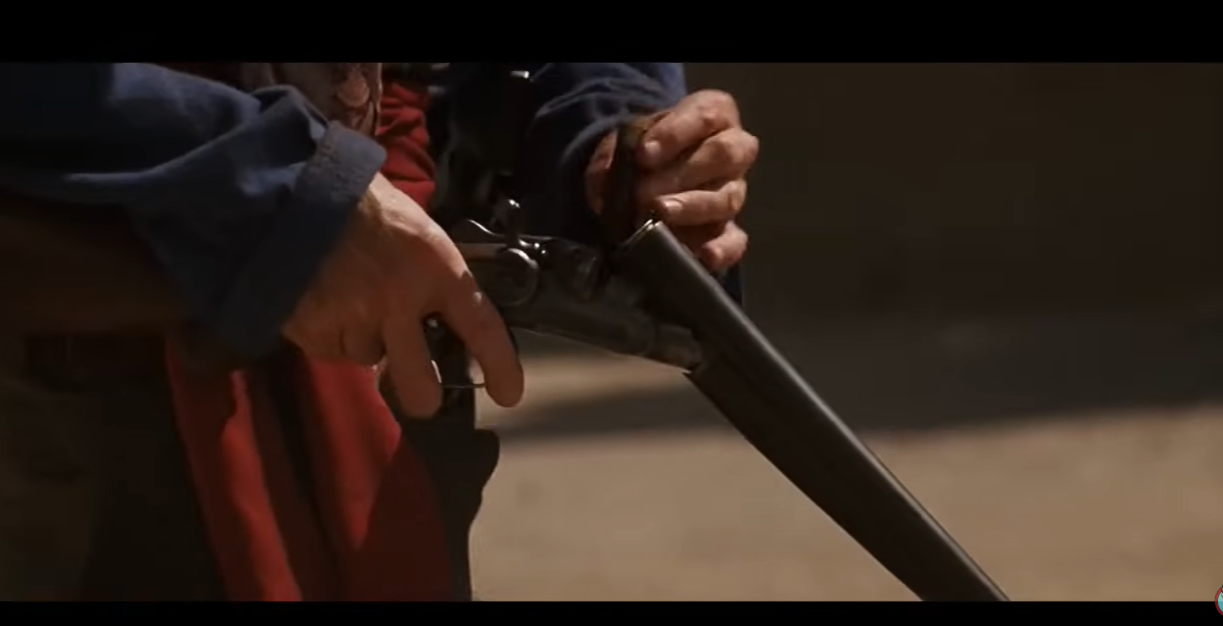
Two men of unusual intelligence.
Two men comfortable with death.
Two men respected and feared for their skill.
But only one of them will walk away.
The wedding sequence quietly prepares us for that later showdown.
It establishes Ringo as more than another outlaw standing behind Curly Bill.
He is a separate threat.
Perhaps an even more dangerous one.
Curly Bill represents chaos.
Johnny Ringo represents darkness with discipline.
And in a film filled with memorable villains, that difference matters.
By the end of the sequence, the joyful world we saw at the beginning has been shattered.
The riders continue.
The dust settles.
The Cowboys move on.
But the consequences remain behind them.
That image captures their role in the story perfectly.
They arrive.
They destroy.
They leave others to live with the damage.
And somewhere among them rides Johnny Ringo—quiet, intelligent, deadly, and disturbingly comfortable beneath the shadow of death.
The Biblical image could hardly be more fitting.
A rider appears.
Death follows.
And behind death comes hell.