HEREDITARY | The Family That Inherited a Nightmare
Hereditary: The Family That Inherited a Nightmare
Some families pass down wealth, traditions, and treasured memories. Others pass down secrets so dark that no generation can escape them. In Hereditary (2018), a family already struggling with grief begins to unravel after the death of its mysterious matriarch. Strange occurrences, horrifying accidents, and disturbing discoveries soon reveal that their suffering may be part of something far more sinister than anyone could imagine.
Directed by Ari Aster and starring Toni Collette, Alex Wolff, Milly Shapiro, and Gabriel Byrne, Hereditary transforms a story about family trauma into a chilling supernatural nightmare. As the truth emerges, one terrifying question remains: what if the greatest danger facing a family is not something trying to enter their home, but something that has been waiting inside their bloodline for generations?
A Grandmother’s Death and a Family’s Secrets
Annie Graham is an artist who creates intricate miniature models of houses and rooms. Her work allows her to recreate entire environments with extraordinary precision, even as her own family life becomes increasingly difficult to control.
When her mother, Ellen, dies, Annie attends the funeral with her husband, Steve, and their two children, Peter and Charlie.
Ellen was a complicated woman, and Annie’s relationship with her was deeply troubled. Rather than bringing closure, her death forces Annie to confront painful memories and unresolved resentment. During the funeral, she discovers that her mother had maintained relationships and interests that Annie never fully understood.
The loss affects each member of the family differently. Steve tries to maintain stability, Peter withdraws into his teenage world, and Charlie, Annie’s thirteen-year-old daughter, becomes increasingly absorbed in her strange habits.
Charlie is quiet and socially isolated. She collects unusual objects, draws disturbing pictures, and constructs peculiar figures from whatever materials she can find. Her behavior seems unsettling, but Annie has grown accustomed to her daughter’s eccentricities.
What the family does not understand is that Ellen’s death has not ended her influence over their lives.
Instead, it has begun to expose a secret that has been carefully concealed for years.
A Night That Changes Everything
Peter wants to live like an ordinary teenager. He attends school, spends time with friends, and tries to establish some independence from his increasingly overbearing mother.
His relationship with Annie is tense. She struggles with her emotions, and their arguments reveal a family already burdened by years of pain.
At the gathering, Charlie accidentally eats cake containing nuts, triggering a severe allergic reaction. Peter immediately drives her away in search of medical assistance.
As they race down the road, Charlie struggles to breathe. She leans out of the car window, desperately trying to get air.
Then, in a sudden and horrifying moment, Peter swerves to avoid an animal.
Charlie is fatally injured.
Peter stops the car, stunned by what has happened. Unable to face the reality of his sister’s death, he returns home and leaves the vehicle outside without telling his parents.
The following morning, Annie discovers Charlie’s body.
Her grief is immediate and overwhelming. The loss destroys the fragile balance within the household, leaving every family member trapped in a different form of suffering.
Peter is consumed by guilt. Annie’s sorrow turns into anger, and Steve struggles to keep the family from falling apart.
But Charlie’s death is not the end of the nightmare. It is the moment when the family’s hidden history begins to reveal its true purpose.
Grief Opens the Door to Something Terrifying
Unable to cope with her loss, Annie attends a support group for people dealing with bereavement. There, she meets Joan, a woman who claims to have communicated with her own deceased grandson.
Joan explains that she has learned a ritual that allows the living to contact the dead.
For Annie, the possibility is irresistible. She wants relief from her suffering and longs to believe that Charlie might still be reachable in some form.
Joan eventually demonstrates the ritual, and Annie becomes convinced that communication with the dead is possible.
But the experience brings disturbing consequences.
Strange noises echo through the house. Unexplained figures appear in the darkness. Annie begins experiencing visions that leave her uncertain about what is real.
Peter also becomes increasingly frightened. He suffers terrifying episodes and begins to feel that something is watching him.
The family’s home, once a place of ordinary domestic life, becomes a landscape of fear. Familiar rooms seem threatening, and darkness conceals things the characters cannot explain.
The film carefully blurs the line between psychological trauma and supernatural horror. Grief can distort perception, and guilt can make ordinary experiences feel unbearable. Yet the events surrounding the Graham family increasingly suggest that something far more deliberate is taking place.
Annie believes she is reaching toward her dead daughter.
She does not realize that the ritual may be helping something else reach toward her family.
The Truth About Ellen Graham
As Annie investigates her mother’s past, she uncovers evidence that Ellen was involved with a secretive occult group.
Photographs, documents, and disturbing symbols reveal connections Annie never suspected. Her mother’s strange behavior was not simply a reflection of an eccentric personality. It was connected to a larger belief system and a plan that had been developing for years.
Annie begins to understand that Ellen’s influence over the family was far greater than she imagined.
The discovery forces her to reconsider everything she knows about her childhood, her mother, and the suffering that has shaped her life.
The family’s tragedies begin to appear connected rather than accidental. Charlie’s unusual behavior, Ellen’s secrecy, and the frightening experiences following the funeral all seem to point toward a hidden design.
The title Hereditary takes on a sinister meaning. The family has inherited more than emotional wounds or destructive patterns. It has become entangled in a supernatural plan whose origins reach back through generations.
Annie realizes that the people surrounding her may have understood the truth long before she did.
The question is no longer simply what happened to her mother or why Charlie behaved so strangely.
It is whether anyone in the family was ever truly free to choose their own future.
A Family Begins to Collapse
As Annie’s discoveries grow more disturbing, her relationship with Steve deteriorates.
Steve wants to understand what is happening through reason. He worries about Annie’s mental state and believes that her grief is pushing her toward dangerous conclusions.
Annie, however, becomes increasingly convinced that the threat is real.
Their disagreement creates a painful divide. The two people who should be supporting one another can no longer agree on the nature of the danger surrounding them.
Peter’s condition also worsens. Haunted by guilt over Charlie’s death, he experiences frightening visions and unexplained physical sensations. He begins to fear that he is losing control of his own mind.
Annie desperately tries to protect him, but her actions become increasingly unpredictable.
The family is trapped in a cycle of fear, suspicion, and emotional destruction. Each attempt to find an explanation seems to lead toward another revelation, and each revelation makes the possibility of a normal future more remote.
Annie’s miniature houses become a particularly disturbing symbol. She constructs entire rooms in exact detail, arranging people and objects within carefully controlled spaces.
Gradually, the images suggest a horrifying possibility: perhaps the Graham family is living inside a structure whose outcome has already been decided by someone else.
The characters believe they are making choices.
But something may have been guiding their lives all along.
The Cult’s Final Plan
The mystery surrounding Ellen and the occult group eventually reveals the true nature of the family’s predicament.
The group worships Paimon, a powerful demon, and has been working to provide him with a suitable human host. Ellen’s involvement was part of a plan designed to bring about his arrival.
The strange events that have haunted the Graham family are not random misfortunes. They are connected to a deliberate effort to prepare the way for the entity.
Charlie’s unusual behavior and the circumstances surrounding her death now take on a darker significance. The family has been caught in a scheme that began long before the opening scenes of the film.
Annie desperately tries to understand what is happening, but the truth offers little hope. The people around her have been manipulating events, and the family’s suffering has helped move the plan toward its intended conclusion.
Peter becomes the central figure in the final stage of the ritual.
As the supernatural forces intensify, he struggles to escape the terror consuming his home. Yet every apparent route to safety leads him deeper into the nightmare.
The horror reaches its peak when the last pieces of the plan fall into place. What looked like a family destroyed by grief is revealed to be part of a carefully orchestrated attempt to bring a supernatural entity into the world.
The tragedy was never simply about what the family had lost.
It was about what something else intended to gain.
An Ending That Leaves No Escape
In the final sequence, Peter’s desperate attempts to escape the horrors surrounding him lead to a terrifying conclusion.
The cult’s plan reaches completion, and Peter becomes the host intended for Paimon. In the treehouse, members of the group gather around him, celebrating the arrival of the entity they have spent years trying to summon.
The revelation is horrifying because it removes the final possibility that the family can simply recover from its suffering.
There is no conventional victory. No one arrives to rescue Peter, expose the conspiracy, or restore the household to normal life.
Instead, the final moments confirm that the forces behind the family’s destruction have achieved their goal.
Peter is crowned as Paimon, while the cultists welcome the completion of their ritual.
The ending forces the audience to reinterpret the entire film. The deaths, the strange behavior, the family conflicts, and the supernatural experiences were connected to a plan that the characters could barely comprehend.
The most devastating element is the sense of inevitability. The Graham family spent much of the story trying to understand its suffering, believing that answers might provide a way out.
But by the time the truth becomes clear, it is too late.
The nightmare has reached the conclusion it was designed to achieve.
Why Hereditary Remains So Disturbing
Hereditary is frightening not only because of its supernatural imagery, but because it builds its horror around recognizable human emotions.
Grief, guilt, resentment, and family conflict are present long before the film fully reveals its occult storyline. The supernatural terror grows from these emotional wounds, making the family’s collapse feel intimate rather than distant.
Toni Collette delivers an intense performance as Annie, a mother struggling to survive unimaginable loss while gradually discovering that her family history is far darker than she believed. Alex Wolff portrays Peter as a young man crushed by guilt and fear, while Milly Shapiro gives Charlie an unsettling presence that becomes more significant as the story unfolds.
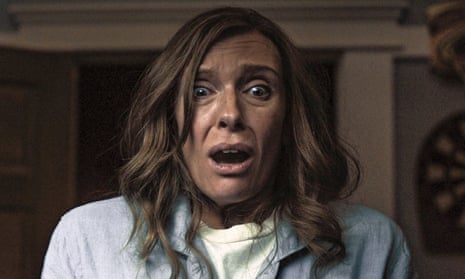
Director Ari Aster uses silence, shadows, carefully composed shots, and disturbing visual details to create an atmosphere of dread. The miniature houses reinforce the film’s central themes of control and powerlessness, suggesting that the characters may be little more than pieces within a larger design.
Ultimately, Hereditary explores the fear that people may inherit forces they never chose and cannot understand until it is too late.
The Graham family searches for comfort after a death. It searches for explanations when tragedy strikes again. And it searches for a way to escape the past.
Instead, it discovers that the past has been preparing its future all along.
Some nightmares begin when the lights go out.
Others begin generations before anyone is born—and wait patiently for the moment when the family finally opens the door.